Dedicated web development team
Hire a web development team that owns the product, not just a backlog of tickets
· Average time to first merged PR: 12 to 15 days
You do not need another pool of interchangeable JavaScript developers. You need a squad that already knows what a healthy Next.js app looks like on a Monday morning, can read a Figma file without asking ten questions, and will not let the Lighthouse score quietly drop 20 points over six sprints.
That is the team we build. Siblings Software is a small Argentine firm that has been staffing web product teams for companies in the US, Canada, UK and Spain since 2014. This page is written for the person evaluating whether to hire us: rates, process, tradeoffs, and the situations where we are honestly not the best vendor.
Who actually hires a web development team from us
Four buyer profiles account for roughly 90% of our engagements.
SaaS teams whose roadmap is bigger than their hiring capacity
You have a product that works, revenue that is real, and a backlog the internal team cannot clear. Recruiting in the US for senior front-end engineers is a three to four month exercise with a 40% offer-acceptance rate. You want a squad that starts shipping this month and whose ramp-down is a 15-day notice, not a severance conversation.
Funded startups that need to ship a product web experience, not a prototype
Seed or Series A. A designer exists, a backend exists in pieces, and leadership has promised a live product to investors. You want a small team that can turn a Figma file into a real Next.js app — auth, billing, observability, design system — and hand it over to your first in-house hires later.
Enterprises retiring a legacy web portal without taking the revenue offline
A PHP or old .NET portal that still prints money and is held together by one person who wants to move on. You want a dedicated team that can do the re-platform screen by screen, keep the old system running, and come out the other end with a TypeScript mono-repo, design tokens, and CI that actually catches regressions.
Agencies and consultancies that need predictable delivery capacity
You win a fixed-scope web build once a quarter. Keeping senior React engineers on the bench between projects is a losing economics. We are your flex capacity: two to six engineers embedded in your delivery squad, white-labeled when needed, with your client never having to know there is a subcontractor in the room.
If none of those describe your situation, we will still take a discovery call and say so in the first fifteen minutes if we are the wrong vendor for you.
What a web development team actually does day-to-day
Most service pages stop at "we do React and Node." That is not very useful if you are trying to decide whether to hire one. What follows is the concrete work we see on Monday stand-ups, with the tradeoffs that separate a real senior engineer from someone who finished a bootcamp twelve months ago.
Product surfaces, not just components
Building dashboards, onboarding flows, pricing pages, admin consoles and account settings that users actually finish. That means thinking about empty states, loading strategies, error boundaries, skeleton screens, and what happens when the API returns 429. The easy 80% of a component is the first day. The remaining 20% is what buyers are paying for.
Design system ownership
Design tokens synced with Figma variables, component library in Storybook, visual regression with Chromatic or Playwright, and the tedious governance work nobody volunteers for: deprecation notices, migration codemods, accessibility linting. When the design system is healthy, feature velocity goes up quietly. When it rots, the feature team gets blamed.
Performance, honestly measured
Real User Monitoring, Lighthouse CI, bundle analysis, route-level code splitting, edge rendering where it makes sense and server components where it makes sense. We lean on the Core Web Vitals documentation as the bar. Regressions are a blocker, not a ticket for next sprint.
Accessibility that survives sprint pressure
Semantic HTML, keyboard-first flows, proper ARIA patterns, screen reader passes on each release, and colour-contrast checks in CI. We use WCAG 2.2 as the baseline and treat accessibility bugs the same as functional ones. Not glamorous. Not optional.
Back end that the front end can trust
Node.js (Express, NestJS, Fastify) or .NET or Django, depending on what your stack already looks like. Typed contracts with the front end through tRPC, GraphQL or OpenAPI. Queues, idempotent handlers, retries, sensible error payloads. The back-end people and the front-end people are on the same squad, not separate companies.
Release engineering for the web
GitHub Actions, preview deploys on every pull request, feature flags, staged rollouts, and rollback plans written before release day. On Vercel, Netlify, AWS, Cloudflare or your own Kubernetes cluster — the tooling changes, the discipline does not. The Google Search Essentials checks are part of the release pipeline, not a post-launch audit.
Every senior we place has shipped at least one production web platform end-to-end. Most have five or more, across fintech, health, SaaS, retail and media.
Engagement models and what they cost
We publish ranges because secret pricing wastes everyone’s time. The final number depends on seniority mix, English level (some clients pay a premium for engineers who are genuinely fluent), and whether you need specialists such as a staff-level accessibility lead or a performance engineer.
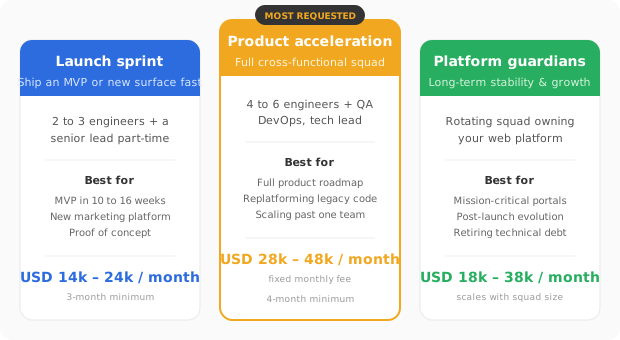
Launch sprint
Two to three engineers plus a senior tech lead part-time. Good when you need to validate a new product line, rebuild a landing experience, or ship an MVP that has to look and feel production-grade on day one. Works well with a Next.js team for marketing surfaces or a React squad for in-app work.
Minimum: 3 months to justify ramp-up.
Product acceleration squad
Four to six engineers with a mix of front-end, full-stack and back-end skills, plus QA automation, DevOps support and an embedded tech lead. The setup we use when the roadmap is locked in and the bottleneck is delivery throughput. Typical stacks: React + Next.js + Node.js, or Angular + .NET. Extends cleanly with full-stack engineers or Node.js specialists.
Minimum: 4 months.
Platform guardians
A rotating squad that owns a mature web platform long-term: technical debt retirement, observability, performance audits, accessibility compliance and small features that keep the revenue-generating code healthy. Often runs alongside an internal product team that handles strategy while we handle the engineering plumbing.
Minimum: 6 months.
Numbers assume 40-hour weeks, a senior-and-mid mix, and include recruiting, laptops, benefits and local taxes. They do not include third-party services like Vercel, Sentry, Datadog, Auth0 or Stripe — those stay on your accounts so you keep control.
How the hiring process actually runs
From the first email to a merged pull request in about two weeks.
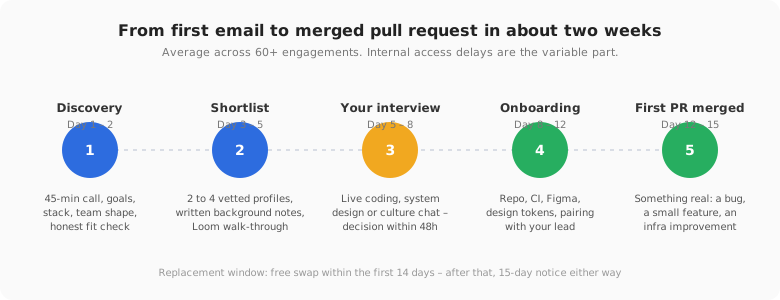
- Discovery (day 1 to 2). 45-minute call. We ask about the product, the stack, the team shape, seniority mix, time zones, and what success looks like in 90 days. If the fit is wrong — you need a 2,000-person vendor or a single 20-hour freelancer — we say so here.
- Shortlist (day 3 to 5). You get 2 to 4 profiles per role with written background notes and a 5-minute Loom from each engineer walking through a recent production project. No anonymous resumes. No wasted interviews.
- Your interview (day 5 to 8). Run it the way you already run interviews — live coding, system design, culture chat, pairing exercise, or all of them. We join the first one if helpful, otherwise we stay out. Decision within 48 hours.
- Onboarding (day 8 to 12). Laptop, repo access, Figma seats, CI credentials, Sentry, feature flags, secrets manager. We have a one-page checklist so nothing is forgotten. Engineers pair with yours on the first ticket.
- First PR merged (day 12 to 15). Something real: a bug fix, a small feature, an infrastructure improvement. The point is to validate the workflow, not to impress. If the first PR takes longer, we usually find the blocker is access, not skill.
- Replacement window (first 14 days). If the match is wrong, we swap at no cost and carry the overlap. After that, 15-day notice either way. Contracts are month-to-month beyond any agreed minimum.
Siblings vs freelancers vs in-house vs generic offshore
Most of our prospects have already tried at least one of the alternatives. Here is an honest comparison. If a row does not match your own experience, tell us on the first call — we will adjust.
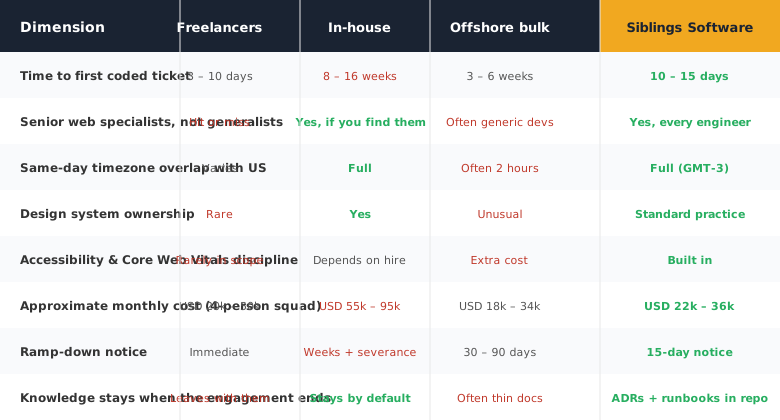
Where freelancers win
Narrow, well-scoped tasks. A Lighthouse cleanup on a marketing site, a one-off Stripe integration, a tricky animation, a single component rebuild. If the work is under 80 hours and the spec is clear, a specialist freelancer is often cheaper and faster than anyone else.
Where freelancers hurt
Continuity. They take vacations without warning, juggle three other clients, and rarely do the unglamorous work — release pipelines, Storybook maintenance, accessibility regressions — because it is not billable in an obvious way. You end up with fast tickets and a slow platform.
Where in-house wins
Long-term product ownership. If web is your permanent center of gravity and you can afford a three-to-four-month search, a full-time employee who will still be there in five years is irreplaceable. We have clients who start with us, see what "good" looks like, and then hire from their own team. That is fine — the goal is a healthy platform, not vendor dependency.
Where in-house hurts
Speed and regret. A senior React hire in the US is a long funnel that often fails on the first or second offer. Meanwhile the roadmap stalls. And if the hire turns out to be the wrong fit at month four, you are looking at severance, not a 15-day notice.
Where large offshore agencies win
Warm bodies at low rates when the work is genuinely generic — internal back-office tools, CMS skins, clone projects. If your requirement is truly "hire ten React developers and assign them tickets", they are built for it.
Where large offshore agencies hurt
The engineer who takes the interview is often not the engineer who writes the code. Time-zone overlap is usually two to four hours. Design systems, accessibility and performance are treated as extra scope instead of baseline. And the notice period to ramp down is typically 30 to 90 days.
Where we fit in
Between the two. We are a small, senior team in a timezone that works with US Eastern and most of Europe. You interview the exact engineer who will write your code. We treat design system, accessibility and performance as part of the default scope. And our minimum commitment is 3 to 6 months, not 12 to 24.
For gaps that really only need one or two engineers, our staff augmentation service is usually the better fit — same engineers, different commercial model.
Real hiring scenarios we see repeatedly
These are composites from actual engagements. Specifics anonymized, numbers rounded, but the shapes are real. They are here because buyers often want to know whether their situation is a thing we have seen before.
Scenario A — the stalled SaaS roadmap
Context. US B2B SaaS, around 4% monthly churn, product team of nine. VP Engineering had three React roles open for four months. The roadmap committed to investors included a full admin console rebuild and a new billing experience.
What we did. Placed a squad of four — one senior React, one senior full-stack, one mid, one QA automation — embedded inside the product team’s Slack. Took over the billing epic from day one. Internal engineers owned the admin console with us pairing on the hardest bits.
Outcome. Billing shipped in 14 weeks against a 20-week internal estimate. Admin console delivered one sprint late. Two of our engineers stayed for another seven months.
Scenario B — the MVP that needed to feel real
Context. Seed-funded healthtech in New York. Figma ready, backend half built on Supabase, zero front-end engineers. Investors had been shown a clickable prototype and expected a live app by Q3.
What we did. Launch sprint: one senior Next.js engineer, one mid, and a tech lead for 10 hours a week. Next.js App Router, tRPC against the existing Supabase schema, Tailwind, Storybook from week two, Playwright from week four.
Outcome. 13 weeks to a production app with auth, billing, onboarding, care-team dashboard, and a Lighthouse performance score of 96. Squad reduced to one engineer for three more months, then handed off to their first in-house hire.
Scenario C — the legacy portal replatform
Context. European logistics company with a PHP 5 customer portal from 2014 and a lot of tribal knowledge in one engineer who was a year from retirement. The portal handled quoting, booking and invoicing.
What we did. Product acceleration squad: a tech lead, three senior engineers, one QA and one part-time DevOps. Next.js on the edge for the customer surface, NestJS on the existing MySQL schema, strangler pattern screen by screen, feature flags to toggle traffic.
Outcome. 11 months, zero revenue-day downtime, 78% of screens on the new stack at hand-off. Two of our engineers were hired directly at the end. We do not use non-competes.
Scenario D — the agency overflow
Context. Mid-size US digital agency had sold a 5-month React build to a retail brand, and their senior front-end lead had just resigned.
What we did. Two senior React engineers under the agency’s delivery lead, white-labeled (our contract with the end client was never visible). Daily standup in the agency’s Slack, PRs in their GitHub, reviews by their tech director.
Outcome. Project delivered on the original deadline. The agency brought us back three more times in the following 14 months and eventually formalized a preferred-vendor arrangement.
Mini case study
How a dedicated squad cut a payments portal’s onboarding time by 42%
Client. Viking Services, a Minnesota-based payment specialist serving roughly 3,400 small-business merchants. Their internal operations team was losing three to four hours a day to a PHP portal from 2016 that made every KYC check manual and every compliance step a spreadsheet round-trip.
Brief. Hire a dedicated web development team that could retire the legacy portal without putting merchant onboarding offline for a single day, and hand Viking a platform their own engineers could own afterward.
What we did. Assembled a six-person squad: a tech lead, two Angular engineers, one senior Node.js engineer, a QA automation specialist, and a UX designer. We ran an eight-week discovery-plus-strangler plan: instrumented the legacy portal with OpenTelemetry so we could see which endpoints still mattered, rebuilt the top ten merchant-facing screens in Angular against a new NestJS API, and kept the old system serving traffic until each screen passed a parity checklist. Design tokens were documented in Storybook from sprint three so Viking’s internal team could extend the library without us.
Result over six months. Merchant onboarding time dropped 42%. Twelve compliance touchpoints that used to be manual became auditable, role-based flows. The cutover weekend had zero minutes of downtime thanks to staged traffic routing. Two of our engineers stayed for six more months at reduced capacity to hand over the observability stack and release runbooks.
Honest caveat. The first four weeks felt slow. The discovery work did not produce demo-able features, and Viking’s leadership had to hold the line internally. If you compare weekly shipped features, any freelancer would have looked more productive in month one. By month three, the compounding started to show.
At a glance
Industry: Payments / merchant services
Engagement: 6-person dedicated team, 6 months + maintenance tail
Stack: Angular 17, NestJS, PostgreSQL, Storybook, OpenTelemetry
Onboarding time: −42%
Compliance steps: 12 automated
Cutover: Zero-downtime staged rollout
The risks of hiring a web development team, and how we handle them
Any vendor who tells you outsourcing a web team is risk-free is either lying or inexperienced. Here are the four failures we see most often — in our engagements and in the ones prospects describe when they switch to us — and the specific controls we use against each.
Risk: a senior who looks great on paper stalls in week three
How we handle it. Two-week free replacement window. Our vetting ends in a live pair session on a real React or Node bug, not a Leetcode puzzle. And the account lead checks in with you specifically at day 14 with one question: "if this were a full-time hire, would you keep them?". We have swapped two engineers in the last 18 months. Both times within the free window.
Risk: knowledge walks out the door when the engagement ends
How we handle it. Documentation is a standing line item, not a favour. ADRs for architectural decisions, READMEs for every non-trivial module, runbooks for production incidents, Storybook entries for every component. If you end the engagement tomorrow, your internal team has the map.
Risk: the design system slowly decays under feature pressure
How we handle it. Design system health is a scorecard, not a gut feel. We track token adoption, Storybook coverage, accessibility lint failures and visual regression diffs per sprint. If the numbers slip, it shows up in the weekly report the same week, not six months later when the VP of Design finally notices.
Risk: Core Web Vitals quietly regress and SEO traffic drops
How we handle it. Lighthouse CI on every pull request, Real User Monitoring in production, and a weekly snapshot of LCP, INP and CLS by route. A regression blocks the merge. The data sits in your dashboard, not ours — see the web.dev Core Web Vitals guide for the measurement definitions we use.
Why Siblings Software specifically
Decide based on facts, not slogans.
11+
Years staffing web teams
Founded 2014 in Córdoba, Argentina
120+
Web platforms shipped
SaaS, fintech, health, retail, logistics
GMT-3
Argentina timezone
Full same-day overlap with US Eastern
We are deliberately small. There is no sales organization pushing headcount. The founders — one of them, Javier Uanini, still does most discovery calls personally — review every engagement. Our engineers talk to clients directly from week one. That is the actual reason onboarding is fast: nobody in the middle translating.
Things buyers usually get wrong when shopping for a web dev team: asking for an hourly rate before explaining the work (you will be quoted the lowest possible number and the real cost will arrive as change orders later), insisting on anonymous CVs before any call (we will not share personal data before a basic NDA, and neither should you want us to), and believing that a bigger agency means more reliable delivery (in web product work, small and senior beats large and generic almost every time).
Frequently asked questions from buyers
Our standards
Web product work treated like the main thing, not a side quest.
- Observability before day one. Sentry, Datadog, Lighthouse CI or your tool of choice configured before the first feature ships. You cannot fix what you are not measuring.
- Design system as a product, not a side-effect. Tokens live in Figma and in code, Storybook coverage is a scorecard, accessibility lint failures block pull requests.
- Releases as a discipline. Preview deploys, feature flags, staged rollouts and rollback plans written before release day, every time.
- Written artifacts. ADRs for architectural decisions, READMEs for every non-trivial package, runbooks for production incidents. This is what makes the handover painless if we ever leave.
- Honest escalation. If a milestone is slipping or a technical choice was wrong, we say so in the weekly update, not at the retrospective two sprints later.
Talk to Siblings Software
Tell us about the product and the team. We will reply within one business day, or say so if we are the wrong fit.