Hire a TypeScript Development Team That Ships Production Code, Not Prototypes
We assemble dedicated TypeScript development teams out of Argentina for product companies that need a senior React, Next.js and Node.js squad without building an in-house recruiting pipeline. You get a tech lead, senior engineers and a QA owner who work exclusively on your product, use your repositories and your standups, and can ship their first pull request within about three weeks of the initial call.
Most of our clients come to us after three specific pains: the typed monorepo is slowing down instead of speeding up, a previous contractor left a codebase full of any, or a promising Next.js product cannot clear a compliance review because nobody documented the architecture. We take teams out of that hole and keep them out.
Who actually benefits from hiring a TypeScript team with us
Over the last decade at Siblings Software we have placed TypeScript engineers into fintech, logistics, healthtech and B2B SaaS products. Four buyer profiles show up in almost every discovery call. If you recognize yourself in one of them, a managed TypeScript squad will usually outperform both freelancers and most local agencies.
Seed or Series A founders with a React product and no CTO
You have paying users and a working Next.js app, but everything above the component layer is an accident. You need senior engineers who can clean up the data layer, introduce a proper test strategy and still ship features every week.
Scale-ups with a stretched internal team
Your core engineers are strong but outnumbered. Bug backlogs grow faster than features. You want a pod that owns a bounded part of the product (checkout, admin, integrations) rather than more individual contractors diluting your roadmap.
Engineering managers replacing agencies
You inherited an agency relationship that was never accountable for outcomes. You need a dedicated development team with a named tech lead and written weekly deliverables, not a rotating roster of junior devs.
Non-tech companies running a flagship web product
Retail, media, professional services. TypeScript is not your core business, but your customer-facing app is. A managed squad lets you ship and keep a small internal owner happy without building a full mobile or web practice.
What you actually get when you hire a TypeScript team
A named pod, written rituals, code you can read six months later.
There is a version of "hiring a team" that deserves its bad reputation: a folder of CVs, a Slack channel full of junior developers and three months of almost working code. We do not do that. Every engagement has a Siblings Software tech lead who is personally accountable for the output, senior Kotlin-style discipline applied to TypeScript, and a delivery lead on our side so your internal manager is not also the project manager.
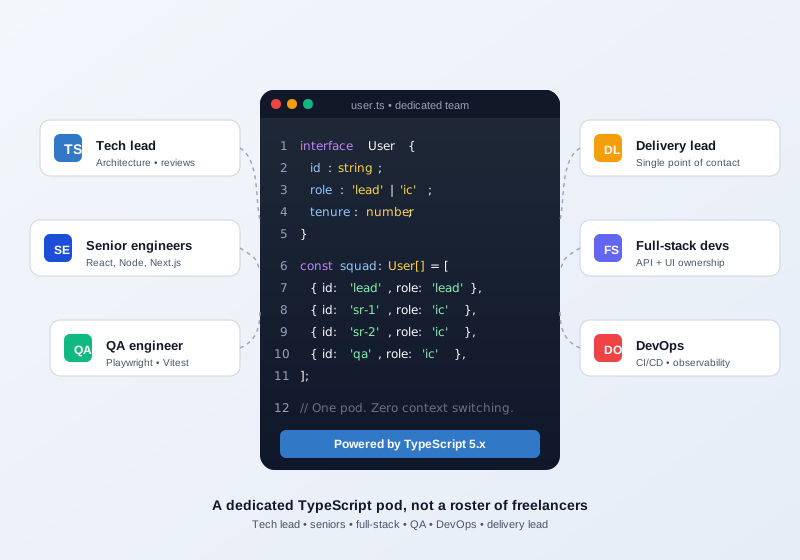
In concrete terms, a typical TypeScript pod includes a senior tech lead, two to four senior or staff engineers, a QA engineer with automation experience, part-time DevOps, and an embedded delivery lead. The stack we write every week: TypeScript 5.x strict mode, React or Next.js, NestJS or Fastify on Node.js, Prisma or Drizzle against Postgres, Vitest and Playwright for tests, Turborepo or Nx for monorepos, and GitHub Actions for CI. On infrastructure we are comfortable with Vercel, AWS and Google Cloud. For shared data types end to end we frequently reach for tRPC or generated OpenAPI clients.
What you should actually expect from week one: a README that is honest about how things work, a dependency graph that fits in your head, TypeScript errors surfaced at CI time rather than runtime, and pull requests that come with their own test plan. The official TypeScript Handbook sets the baseline for language decisions; we bring the part that the handbook cannot teach, which is what to do when a real codebase has fifteen years of inherited assumptions.
Engagement models and realistic pricing
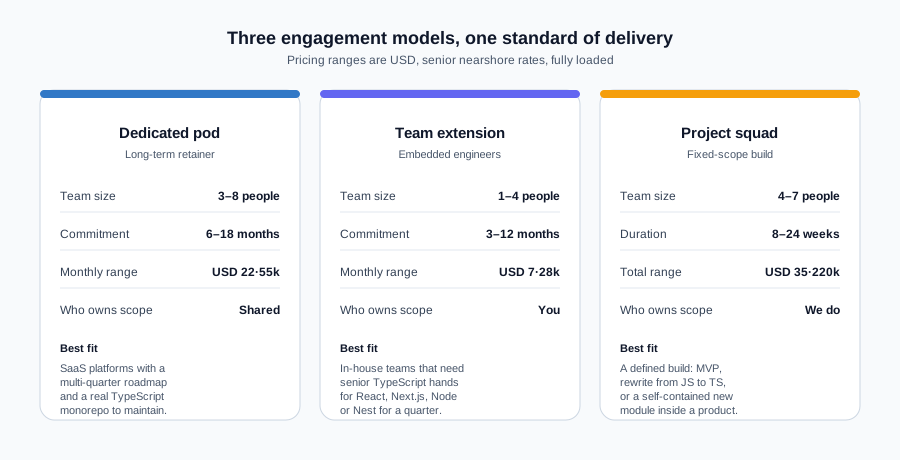
We sell three engagement models for TypeScript teams. Pick the one that matches your scope control and risk appetite. We share actual price bands because we have seen founders burn months because nobody would give them a number in writing.
Dedicated TypeScript pod
A long-term retainer with a named tech lead and a team sized to your roadmap. Best when you expect at least two quarters of TypeScript work and you want the same people learning your domain. Typical range: USD 22,000 to 55,000 per month depending on seniority and team size.
Team extension
One to four senior TypeScript engineers embedded in your existing team. You own the backlog, we own the individuals. A good fit when you already have an engineering manager and a clear sprint process. Typical range: USD 7,000 to 28,000 per month.
Project squad
A fixed-scope build: a migration from JavaScript to strict TypeScript, a Next.js rewrite, a new admin platform. We quote a deliverable, a release date and a written change-control process. Typical range: USD 35,000 to 220,000 total over 8 to 24 weeks.
A note on the bands: these are real numbers we quote in 2026, anchored in senior nearshore rates. A precise number needs a 45-minute call; larger projects benefit from a short paid discovery before we lock anything in. We never ask for a retainer before an engineer actually starts work.
How hiring a TypeScript team actually flows
Our hiring process is boring on purpose. No sales theater, no sudden CV dumps, no bait-and-switch between interview and delivery. Here is the calendar most clients experience.
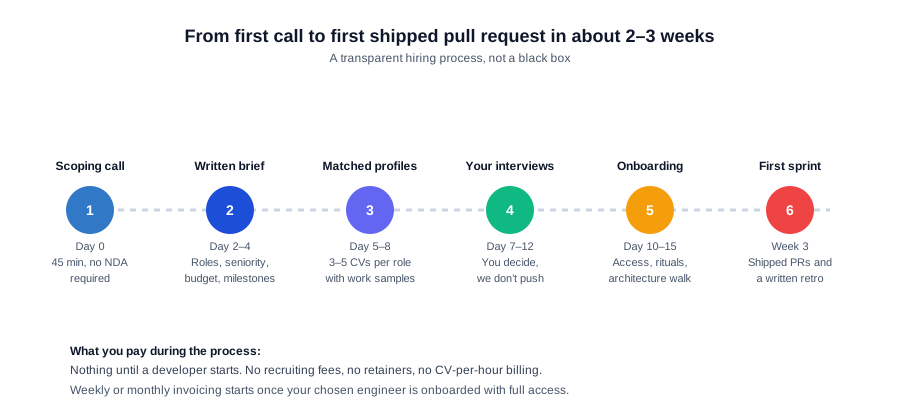
- Scoping call. A 45-minute conversation with the delivery lead who would run your engagement. We map your stack, constraints, in-house skills and deadlines. No NDA required for this step.
- Written brief. Within 48 hours we send a one-page brief with proposed roles, seniority, budget ranges and milestones. You either approve it, adjust it or kill the conversation at no cost.
- Matched profiles. We present three to five profiles per open role with work samples, a written technical summary and salary bands. The bench is not anonymized: real names, real GitHub handles when public, real LinkedIn.
- Your interviews. You run your own technical interview. We suggest a prompt if you do not have one, but you control the rubric and the decision. We do not push candidates.
- Onboarding. Access to your repositories, your CI, your docs and your Slack. A paid onboarding week during which the team writes an architecture note and ships a first small pull request.
- First sprint and written retrospective. At the end of the first two-week sprint we share a written retrospective: what shipped, what broke, what we misjudged. That document sets the baseline for every future sprint.
For a deeper look at how we manage delivery over time, our agile delivery practice is the honest reference. Nothing in it is novel. The point is that we actually do it every sprint.
Realistic TypeScript projects we staff every quarter
A sample of the shapes of work that come up in most scoping calls. If you can describe your project as a cousin of one of these, we can almost certainly put the right people on it.
Next.js App Router rewrites
Teams migrating from the Pages Router or a legacy Create React App base into the Next.js App Router, with server components, streaming and proper caching. Usually paired with a Postgres schema cleanup.
Strict-mode TypeScript migrations
Codebases with strict: false, thousands of any types and a frontend test suite everyone fears. We do the migration file by file behind feature flags, with measurable progress reported weekly.
NestJS and Fastify backends
Production APIs for B2B SaaS products: auth, billing, webhooks, queues, observability. Paired with our back-end practice when infrastructure design is also in scope.
Internal tools and admin dashboards
React Admin, Refine or custom Next.js backoffices for operations, customer success or finance teams. Often the fastest way to unblock a product team that is serving too many Slack requests per day.
Headless commerce and marketplaces
Next.js storefronts on top of Shopify, BigCommerce or custom TypeScript APIs. Product listing performance, checkout reliability, Core Web Vitals. Frequently paired with our eCommerce development teams.
Shared packages and monorepos
Turborepo or Nx workspaces with shared ESLint, tsconfig, UI libraries and type-safe API clients. We like this work because it pays back with every future feature, not just the current one.
A grounded case study: Almora HQ admin platform
Almora HQ, a Series A property operations platform, hired us in mid-2025 after their previous contractor left behind a Next.js admin built on the Pages Router, a 40·000 line codebase with strict: false, and a test suite that had been red for five months. Their internal team of three engineers could not ship a new feature without breaking two.
We proposed a six-month dedicated pod of one tech lead, two senior TypeScript engineers, one full-stack engineer and a QA owner. The plan was intentionally unambitious: first stabilize, then migrate, then build new features. We measured progress every two weeks against three numbers we agreed on up front: share of files under strict, deploy frequency and production incidents per week.
By month four strict coverage was at 94·percent, deploys had moved from monthly to three times a week, and incidents per week had dropped from seven to one. At that point we migrated the admin to the App Router behind a feature flag over three sprints, without any marketing-visible downtime. Almora extended the engagement for another two quarters and brought a second product area into the pod.
The broader story is documented in our case studies hub. If you want to speak to the Almora engineering manager directly before signing anything, that can be arranged during scoping.
Engagement snapshot
Model: dedicated pod, 6-month retainer, extended
Team: 1 tech lead, 2 senior TS devs, 1 full-stack, 1 QA
Stack: TypeScript 5.4, Next.js App Router, NestJS, Postgres, Prisma, Playwright
Outcome: strict coverage 0% → 94%, deploys monthly → 3∕week, incidents 7 → 1 per week
Hiring a team vs freelancers, in-house and staff augmentation
Most buyers are really choosing between four ways to get a TypeScript team. Here is how we honestly see the trade-offs, including the cases where hiring a managed team with us is the wrong call.
Freelancers on Upwork, Toptal or your network
Cheapest on paper, highest variance. Good for a one-off landing page or a small data script. Falls apart when you need code review, release hygiene, bus-factor resilience or a human to answer at 3 PM on a Friday when staging is down.
An in-house TypeScript team
The right endgame if TypeScript is core to your product and you plan to be on it for years. Wrong answer if you need to ship in six months, you have nobody senior to interview candidates, or you cannot realistically out-compete for senior engineers in your local market.
Classical staff augmentation
You manage the work, a vendor supplies engineers. Fine if you already have a strong engineering manager and a disciplined sprint process. Our staff augmentation practice exists for exactly this case. It is not the same product as a managed team.
A managed TypeScript team with Siblings Software
You get a squad that takes responsibility for delivery, a named tech lead and a written sprint cadence. It is the best fit when you want TypeScript output without hiring a full engineering org. It is the wrong fit if you want to micromanage individuals or pay below senior nearshore rates.
Risks we have seen, and how we mitigate them
We have run enough engagements to have a short, realistic list of things that go wrong. We try to be upfront about each of them because the alternative is a surprise three months in.
Scope creep disguised as "small changes"
Mitigation: every change above one engineer-day goes through a written change-control note. We would rather slow down for an hour than surprise you with a missed release.
A senior engineer that clicks on paper but not in your team
Mitigation: two-week replacement guarantee, plus a calibration call at weeks 2, 4 and 8. We would rather swap early than hope it gets better.
Knowledge siloed in one person
Mitigation: every non-trivial architectural decision lands as an ADR in the repository. Pairing rotations keep at least two people fluent in every part of the system.
Security or compliance gaps
Mitigation: a written security baseline before we merge anything to main (secrets handling, dependency policy, audit logs), plus a named security lead during regulated engagements.
How Siblings Software operates day to day
A few specifics so you know what you are buying, not just a slogan.
- Engineers with 6+ years of TypeScript, not bootcamp graduates. Our senior engineers have shipped TypeScript since the 2.x era and lived through the strict-mode migration debates firsthand.
- Everything is written. Briefs, decisions, retrospectives, pricing changes. If it is not in writing, it is not agreed. This protects both sides.
- Weekly status, not monthly status. A short written update every Friday with velocity, blockers, risks and a next-week plan. Fifteen minutes to read, not a slide deck.
- Your code, your IP. Every engagement starts with a mutual NDA and a Master Services Agreement that assigns all source code and work product to the client on payment.
- Honest rates. We publish bands. We do not discount heavily, we do not hide fees, and we tell you if your budget cannot buy the seniority you need.
- A named human owns your account. Not a shared inbox, not a rotation. One delivery lead for the length of the engagement.
Frequently asked questions about hiring a TypeScript team
Do you work on TypeScript only, or full-stack JavaScript?
Our teams are TypeScript-first but most seniors are equally fluent in modern JavaScript and in the surrounding tooling. If a subset of your codebase is still plain JavaScript, that is fine. We will often migrate it incrementally rather than freeze development to rewrite everything at once.
Can you replace a specific engineer quickly?
Yes. The default two-week replacement guarantee is written into the MSA. In practice we usually know within two or three sprints whether a match is working, and we address it before it becomes a crisis.
Do you run the recruiting for us, or do you have a bench?
Both. About 70 percent of our engineers are on an active bench or rolling off an engagement. For unusual needs (for example deep experience with a specific AI SDK) we also run targeted recruiting, with a written search plan and timeline.
Can we start with one engineer and grow into a pod?
Yes. Team extension is specifically designed for that path. Many of our current dedicated pods started as a single senior TypeScript engineer embedded with an in-house team.
Where are your engineers based?
Most of our team sits in Argentina (Buenos Aires, Córdoba, Rosario, Mendoza). A few senior leads are in Uruguay and Chile. We do not subcontract to other continents without telling you.
What happens at the end of an engagement?
A written handover pack: architecture diagrams, ADRs, runbooks, access list, open risks and a prioritized backlog. We would rather leave a team better equipped than we found it than prolong an engagement artificially.
Ready to hire your TypeScript team?
Tell us what you are building, where the codebase hurts, and what you have tried. We will answer with a written brief, a price range we can actually stand behind, and a short list of engineers you can interview. The first call is a conversation, not a pitch.
If you are deciding between a TypeScript team and a broader full-stack squad, take a look at our full-stack development teams and our Node.js development teams pages. They start from the same bench but solve slightly different problems.
If you are hiring TypeScript engineers from the United States and want US commercial terms, visit the US version of this page.
Contact Siblings Software Argentina
Get in touch and build your idea today.