Outsource Agile Development to a Team That Actually Ships Every Sprint
We run managed agile software development for founders, product leaders and enterprise teams that want to move fast without turning their backlog into a negotiation. Under this model Siblings Software owns the squad, the Scrum process and the release cadence. You own the product, the roadmap and the IP.
Every engagement is built around a short, honest loop: plan, build, review, release, retrospect, repeat. No ceremonies theatre, no 30-page estimates, no mystery velocity charts. You get working software every two weeks and an executive summary you can forward without editing.
Who we build agile teams for
Most buyers looking at agile development outsourcing fall into one of four situations. Recognizing the right one early saves a quarter of wasted onboarding.
Founders without a full-time engineering lead
You have a clear product vision, maybe a working prototype, and a small in-house team. What you do not have is the bandwidth to run sprint planning, code review and hiring at the same time. We plug in a tech lead and an agile squad that sits one layer below you and keeps shipping while you focus on customers and fundraising.
Product teams with a stretched internal roadmap
Your engineers are strong, but three priorities are competing for the same sprint and something always gets pushed. We take a slice of the roadmap, run it with our own cadence, and feed the output back into your release train. No context switching, no fight over who owns what.
Enterprises modernizing legacy platforms
You are rebuilding a system that cannot go down, usually under regulatory pressure. We favor strangler-fig migrations, heavy observability and pair programming so your team absorbs the new stack as we go. We have worked inside SOC 2, PCI and HIPAA environments without slowing the roadmap.
Non-tech companies launching a digital product
Retailers, insurers and service brands whose core business is not software. For these clients we usually deliver a fixed-scope first release, then a modest retainer, then hand the product to a lightweight internal owner with playbooks and training instead of a call center number.
What agile outsourcing really means in 2026
Managed delivery, honest estimates, working software every fortnight.
Agile has earned a bad reputation in some circles, and honestly, it is deserved whenever it gets reduced to ritualized standups, velocity math and burn-down charts nobody reads. We treat the agile manifesto as a working contract, not a decoration. That means optimizing for working software, direct communication with the people who pay for it, and the ability to change direction without a project plan apocalypse.
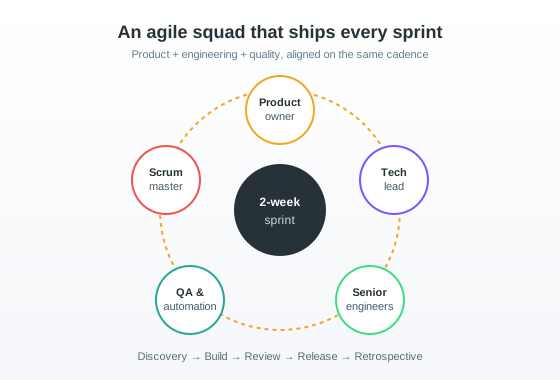
Practically, every squad we run includes an accountable tech lead, senior full-stack engineers, a QA engineer who owns automation, and a Scrum Master who runs the cadence and protects the team from noise. We borrow whatever from the Scrum Guide helps the product and we drop what does not. Most teams run two-week sprints with a Kanban lane for incidents, and we measure delivery with DORA metrics plus the two or three business KPIs the sponsor actually cares about.
On the engineering side we default to trunk-based development, pull request review by a senior, CI on every commit, feature flags for risky changes and observability from day one. We have shipped across React, Vue, Angular, Node.js, .NET, Java, Python, Swift, Kotlin and Go. Stack is never the decisive factor. Whether a squad can estimate honestly, say no to scope creep and keep a clean codebase is.
Engagement models and honest pricing
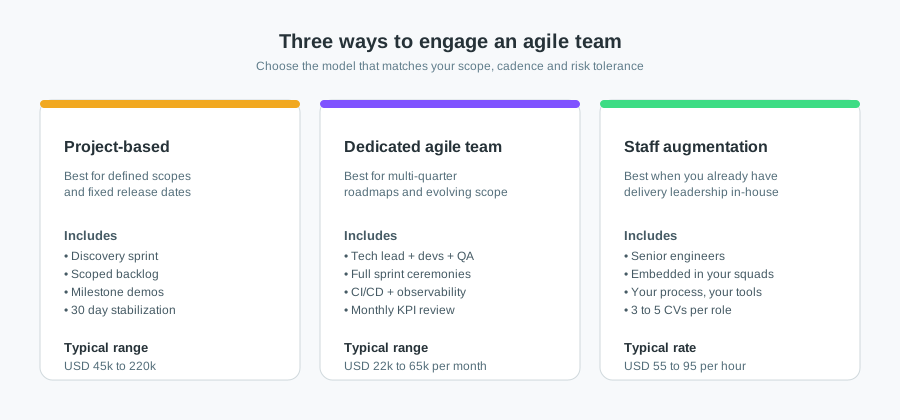
We run three models. They differ in who owns scope, how risk is distributed and how commercial terms are structured. We will tell you which one we think fits your situation before you ask.
Project-based agile outsourcing
You have a defined scope or we write one together during a paid discovery. We quote a deliverable, a release date and a change-control process. You pay against milestones tied to demos, not to calendar days. Typical range: USD 45,000 to 220,000 for a production web or mobile product with backend integration and staged rollout. See our project-based outsourcing page for the commercial details.
Dedicated agile team
A multi-quarter retainer with a tech lead and a team sized to your roadmap. Right fit when you plan at least two quarters of work, need flexibility in scope or want the same people accumulating domain knowledge. Typical range: USD 22,000 to 65,000 per month depending on seniority mix and team size. More on dedicated teams.
Staff augmentation
Your delivery process, your ceremonies, our senior engineers plugged in one by one. Good fit when you already have a strong mobile or platform lead and just need capacity. Typical rate: USD 55 to 95 per hour depending on seniority and stack. More on staff augmentation.
Note on pricing: we share ranges because we have watched too many buyers waste months because nobody would commit to a number. These are the bands we actually quote against senior nearshore rates. A precise estimate needs a call and, for larger programs, a short paid discovery.
How a two-week sprint actually runs on our side
Every engagement follows the same loop. The depth of each step scales with scope, but no step is ever skipped or turned into theatre.
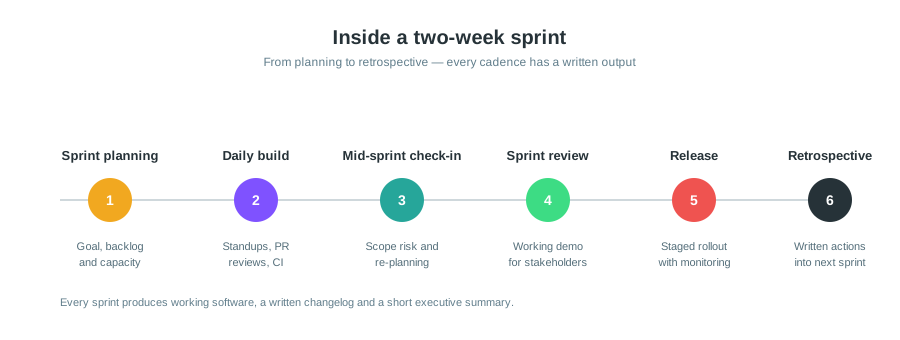
- Sprint planning. The product owner and tech lead agree on one sprint goal, not six. The team estimates in story points, we reserve 15 to 20 percent of capacity for the unknowns and we write down what is explicitly out of scope.
- Daily build. A 15-minute stand-up, focused pull request reviews, CI on every commit, trunk-based branching and feature flags for anything risky. We cap work in progress so nothing sits in review for four days.
- Mid-sprint check-in. A 30-minute sync on day five or six to flag scope risk and re-plan before it is too late. If the sprint goal is in trouble, the product owner hears it now, not at the review.
- Sprint review. A live demo of working software to the stakeholders who asked for it. No slides pretending to be features. We record the demo so people in other time zones can catch up.
- Release. Staged rollout with monitoring, a rollback plan, written release notes and a quick executive summary. On regulated products we coordinate with the security team and hand them a signed changelog.
- Retrospective. Honest, short, written actions. Anything that is not assigned to a person with a date goes in the bin. The first item on the next sprint is usually one of those actions.
Realistic agile use cases
A snapshot of the shapes of work that fit our agile practice. These show up in almost every discovery call.
New SaaS product, zero to first paying customer
Discovery, prototype, MVP, onboarding flow, billing integration and staged public launch. Typical duration: 12 to 20 weeks, one squad plus a part-time designer.
Legacy platform modernization
Strangler-fig migration from a monolith to domain-oriented services, with observability in every deployment. Built to keep the business running and to give your in-house team a new stack they can actually own.
Marketplace and e-commerce platforms
Catalog, search, cart, checkout, payments, promotions, operations dashboard and customer support tooling. Delivered alongside our back-end team and a UX designer embedded in the squad.
Internal tools and operational software
Back-office applications that replace spreadsheets, queues and email threads. The sort of software the market never sees but which saves six-figure operational costs.
Regulated fintech and healthcare products
PCI-conscious payment flows, HIPAA-aware data handling, pen-test remediation windows and audit-ready documentation. We move fast without skipping the paperwork auditors ask for.
Data and analytics products
Event pipelines, warehouses, reporting dashboards and, when it honestly helps, ML components. Delivered with enough observability that your analysts trust the numbers on Monday morning.
Grounded case study: fintech onboarding cut by 42 percent
A New York-based fintech platform came to us with a six-week backlog of onboarding requests and a stretched internal engineering team. Their existing agile process had broken down: three product owners, two legacy codebases and no shared Definition of Done. Releases had slowed to once a month and compliance was learning about delays only at the last minute.
We ran an 18-day paid discovery and launched a blended squad: a product manager, two senior full-stack engineers, a QA automation lead and a Scrum Master, working alongside their internal compliance experts. By the end of sprint three we had shipped a redesigned onboarding workflow, automated KYC checks and a shared analytics dashboard for compliance stakeholders.
The results we measured and reported every sprint: onboarding cycle time down 42 percent, identity-verification conversion up 18 percent, and two new payment processor integrations shipped without breaking PCI scope. When the engagement wound down we left playbooks, code walkthroughs and runbooks so the in-house team could own the rhythm.
Engagement snapshot
Model: fixed-scope project + 3-month retainer
Team: 1 product manager, 2 senior engineers, 1 QA automation, 1 Scrum Master
Cadence: 2-week sprints, weekly exec summary
Outcome: onboarding −42%, IDV conversion +18%
If you want the full technical story, including the dashboards we used to guide decisions, visit our case studies library. A similar healthtech engagement is documented there, where we cut release cycle time by 35 percent and reduced production incidents by 40 percent with the same playbook.
Agile outsourcing vs freelancers, in-house and agencies
Most buyers are really choosing between four ways to build an agile capability. Here is how we see the trade-offs, including the cases where outsourcing is the wrong answer.
Freelancers and marketplaces
Lowest sticker price, highest variance. Fine for a one-person experiment. Falls over when you need shared ownership, code review, release hygiene or someone to answer the phone during an outage.
In-house engineering team
The right long-term answer when software is core to your business. The wrong answer when you need to ship in two quarters, you do not have an engineering lead yet, or you cannot compete for senior talent in your local market. Hybrid approaches work well: we run alongside an in-house core while you scale it.
Generalist consulting agencies
Often strong at strategy and design, weaker at production engineering. Estimates tend to be optimistic because they are written by people who will not be on the call at 2 a.m. when a deployment fails.
Managed agile outsourcing
Our sweet spot. You get an accountable tech lead, a senior Scrum team, written commitments and a shared definition of success. The trade-off: slightly higher cost than a freelancer, and you are trusting a partner with meaningful delivery responsibility. That trust has to be earned sprint by sprint.
Risks we have seen and how we mitigate them
Agile outsourcing can go wrong in very specific ways. After a decade of engagements we have stopped being surprised by the failure modes, and the playbook below is how we keep them out.
Scope creep disguised as agility
“We will just add this one thing this sprint” is how projects die. Every change that affects the sprint goal goes through written change control. The product owner signs off. Nothing slips under the radar.
Low-quality code under a fast cadence
We require senior pull request review, automated tests at the unit, integration and end-to-end level, and observability in every release. If the automated checks go yellow, merges stop until they go green.
Knowledge hoarding
Pair programming, written runbooks, architecture decision records and code walkthroughs are part of every engagement. The aim is always that a future in-house engineer can take over without a week of onboarding.
Opaque progress
Every sprint produces a written exec summary: goals, what shipped, what slipped, why, and the next sprint plan. Stakeholders never have to join a standup to understand where the product stands.
Compliance blind spots
On regulated products a security-minded engineer joins the squad from day one. We track OWASP-aligned security reviews, encrypt data at rest and in transit by default, and keep audit logs that SOC 2 auditors can read without translation.
Partnership drift
Quarterly business reviews with the sponsor, not just the product owner. If the original KPIs no longer matter, we rewrite the goals instead of pretending the old ones still drive value.
Why teams pick Siblings Software for agile delivery
Siblings Software is an Argentina-based software outsourcing and staff augmentation company. Over the last decade we have delivered agile engagements across fintech, healthtech, retail, logistics, proptech and SaaS, working with venture-backed startups, Fortune 500 innovation teams and regulated enterprises in North and South America.
Senior-heavy squads
Every squad is staffed with engineers who can design systems, not just implement tickets. Juniors exist inside our teams but they do not set direction.
Overlap with North American hours
Argentina is one to two hours ahead of US Eastern Time. We work same-day, not with a 12-hour lag, which changes what agile actually feels like.
Our benchmarks, not ours alone
We calibrate delivery against the DORA research and the Atlassian agile reference, and we stay active in communities such as the Cloud Native Computing Foundation and Scrum.org.
Security and compliance without drama
SOC 2-ready processes, OWASP-aligned security reviews, data handling calibrated to HIPAA and PCI when the product demands it.
Tools we already know
Jira, Linear, Azure DevOps, GitHub Projects, Notion, Slack, Teams. We adapt to your stack and your ceremonies instead of forcing ours.
A written engagement plan
Before sprint one you receive a squad charter, a Definition of Done, a KPI sheet and a risk register. No “we will figure it out on the way” onboarding.
What clients usually get wrong before calling us
These are the three decisions we see buyers regret most often. They are not about budget. They are about how the engagement is framed on day one.
- Picking staff augmentation when they need managed delivery. If you do not have an engineering lead ready to run standups and unblock engineers every day, individual contractors will feel slow and unaccountable. You probably want a managed squad.
- Skipping discovery to “save time”. Every engagement that starts without a paid discovery pays for it later in missed expectations. A two-week discovery costs less than one misaligned sprint.
- Hiring for velocity instead of outcomes. Story points are a planning tool, not a KPI. Sponsors who measure the team on velocity end up with inflated estimates and disappointing products. We measure impact, not tickets.
Frequently asked questions
Straight answers to the questions buyers ask on the first call. If something is missing, ask us directly in the form below.
An accountable tech lead, senior full-stack engineers, a QA automation owner and a Scrum Master, all running two-week sprints with written Definition of Ready and Done, CI/CD pipelines and stakeholder-level sprint reviews. You own the product, the roadmap and the IP.
Most squads go from signed contract to productive sprint one in 10 to 21 business days. We use that window to interview candidates with you, run a paid discovery, set up tooling and agree on KPIs before a line of code is written.
Fixed-scope projects typically land between USD 45,000 and 220,000. A managed dedicated agile team usually runs USD 22,000 to 65,000 per month. Senior engineers embedded via staff augmentation are between USD 55 and 95 per hour.
Scrum with two-week sprints by default and a Kanban lane for incidents. We work inside Jira, Linear, Azure DevOps, GitHub Projects or Notion. We pair DORA metrics with the two or three business KPIs a sponsor actually cares about.
Scope is expected to evolve. Anything that changes the sprint goal goes through light written change-control: the product owner approves and the estimate updates before the work enters the backlog. Nothing silently slips.
Yes. Every engagement starts with a mutual NDA and a Master Services Agreement that assigns all work product, source code and derivative rights to the client on payment. We can work inside your repositories, cloud accounts and tooling if you prefer.
We run pair-programming sessions, update documentation, record architecture walkthroughs and train the owners. Most clients keep a fractional retainer with us for one or two quarters while their internal team scales up.
Related services
Explore the adjacent engagements we deliver with the same senior teams and agile cadence.
Hire a dedicated agile team
Long-term squads embedded in your roadmap, mirroring your ceremonies and tools.
Hire agile developers
Handpicked senior engineers who plug into your squads and mentor internal engineers through pair programming and code review.
Software development outsourcing
The broader set of outsourcing engagements we deliver, from discovery to production.
Looking for this page in Spanish? See our agile development page in Spanish.
Talk to Siblings Software Argentina
Tell us the problem, the deadline and the constraints. We will reply within one business day with a written next step, not a generic proposal.