Hire an Offshore Development Team Without the Usual Offshore Problems
We build dedicated offshore development teams out of Argentina for product companies in the United States, Canada, the United Kingdom and the rest of Latin America. You get senior engineers, a tech lead, QA and DevOps who join your sprint, your repository and your standups, and who are accountable as a pod for delivery, quality and releases. Not a pool of anonymous contractors and not a body shop.
Most clients reach out after an earlier offshore experience that went sideways: scope that was never written down, turnover every few months, code no one internal can maintain, timezone mismatches that killed momentum. This page is how we think about fixing that pattern, with real numbers, a concrete hiring process and the trade-offs we think buyers should actually weigh.
Who actually hires an offshore team from us
Offshore is not the right answer for everyone. After close to a decade running distributed engineering pods, we have noticed four profiles where a managed offshore team consistently outperforms hiring locally, going freelance or signing with a generic outsourcing agency.
Seed and Series A startups with a stretched CTO
Your CTO is shipping code between investor calls. You need two or three senior engineers who can pick up backend services, an admin panel or a mobile client without supervision, and who will not disappear when the round closes. A starter pod usually fits here.
Scale-ups that cannot hire fast enough in their local market
You have a roadmap that needs six more engineers this quarter, recruiting has been slow for months, and every senior candidate is asking for packages that break your budget. Offshore absorbs capacity without compromising the quality bar your current team has already set.
Enterprises with one product line that never gets prioritised
Internal Kubernetes and a new data platform take all your best engineers, so the customer-facing product slips to quarterly releases. A full-stack squad owns that product end to end and reports to your product leader directly, while the core engineering org focuses on strategic bets.
Non-tech companies that need real software, not an agency project
Retailers, logistics operators, media groups and professional services firms whose business is not software but whose customers now expect a native Android app, a modern portal or a proper data platform. We deliver the product and hand it to a lightweight internal owner.
Where offshore is the wrong answer: very early zero to one discovery where the founder still changes the product weekly, regulated workloads that require on-site presence, and teams of one where you really need a senior in-house hire. We will tell you if that is the case.
What offshore development really means in 2026
A managed pod, not a pile of CVs.
The cheapest version of offshore development is the one that earned the whole category its reputation: a staffing agency shows you thirty CVs, you pick three, they get assigned somewhere in a twelve-hour time zone gap, and six months later you are debugging a codebase you do not recognise. We think that version is extinct for companies that care about their product, and it is certainly not what we sell.
When we say offshore development team, we mean a small group of engineers that behaves like an in-house squad. You get a named tech lead who is personally accountable for delivery. You get senior developers, not juniors badged as mid-level. You get a QA engineer who owns automation and release hygiene. And you get a delivery lead on our side who writes the brief, tracks the sprint and catches problems before they reach you.
Practically, our pods work on your stack rather than on ours. We have shipped production code in TypeScript with React and Next.js, Python with Django and FastAPI, Go, Kotlin on Android, Swift on iOS, .NET with ASP.NET Core, Node.js, Ruby on Rails, PHP with Laravel, Java with Spring Boot, and the usual cloud and data layer (AWS, GCP, Azure, PostgreSQL, MongoDB, Redis, Kafka, Kubernetes). We follow standards like continuous delivery and the practices described in Google's DevOps research reports because they are the cheapest way we know to keep a distributed team honest.
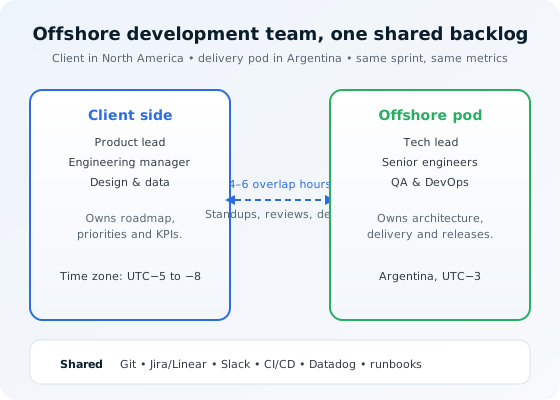
Argentina is a useful detail. Our team sits in UTC minus 3, which leaves four to six hours of direct overlap with every United States time zone and a clean morning window for European clients. That is why a lot of what gets sold as offshore from our end actually behaves more like nearshore collaboration. You can still get standups, pair programming and PR reviews in real time.
Engagement models and honest pricing
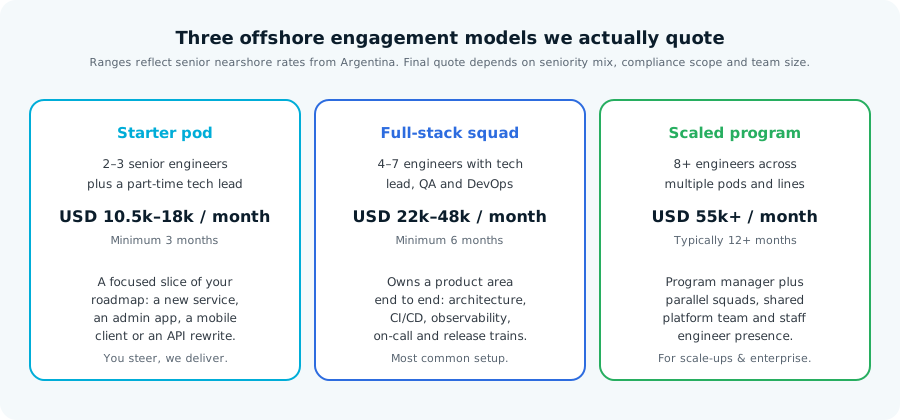
We quote offshore engagements under three shapes. Each is good at something specific, and the price ranges below are the bands we actually put on proposals during 2026. They are not a sticker price: a precise number needs a scoping call and, for larger programs, a short paid discovery.
Starter pod
Two to three senior engineers and a part-time tech lead focused on one piece of your roadmap. Right for a new service, a mobile client, an internal admin app or the first version of a data pipeline. Typical range: USD 10,500 to 18,000 per month with a 3-month minimum.
Full-stack squad
Four to seven engineers with a full-time tech lead, QA and a DevOps engineer. Owns a product area end to end: architecture, CI/CD, observability, releases and on-call when you need it. Typical range: USD 22,000 to 48,000 per month with a 6-month minimum. This is the most common setup.
Scaled program
Eight or more engineers across two or three pods with a program manager, a shared platform team and a staff engineer presence. For scale-ups rebuilding a core product, or enterprises replacing a legacy vendor. Typical range: USD 55,000+ per month, usually 12-month+ commitments.
On hourly rates: senior engineers from our Argentina practice land roughly between USD 55 and 90 per hour depending on seniority and scope, which is typically 40 to 60 percent below a comparable US hire and similar to mid-tier agencies in Eastern Europe. We publish bands because we have seen too many buyers waste three months shortlisting vendors who will not name a number until the contract stage.
The hiring process, week by week
Offshore hiring is usually either too slow (months of account-management ping-pong) or too fast (three CVs on day one, one of them is always the same person). We aim for the middle: six to eight weeks from the first call to a first production release, with a clear decision point at the end of each step.
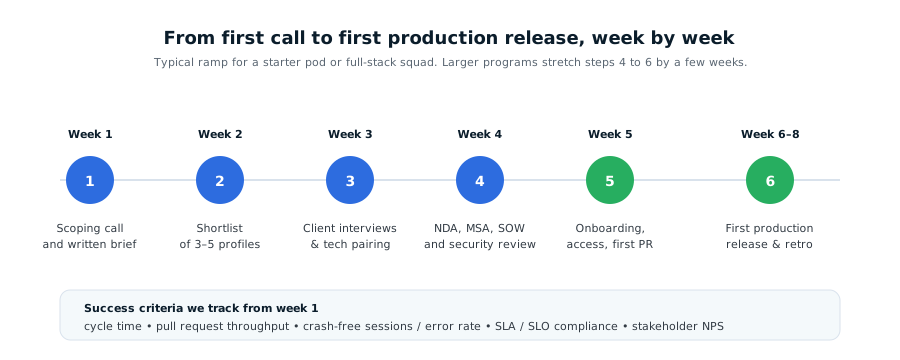
- Week 1 – Scoping call and written brief. A 60 to 90 minute working session with your product and engineering leaders. We walk out with a written brief describing goals, current state, stack, integrations, constraints and success metrics. You sign off on it. Everything downstream refers back to it.
- Week 2 – Shortlist. We share three to five engineer profiles per role, with real links to work, public repos where they exist, and a short internal note explaining fit. No stock CVs, no rebranded resumes. If a profile does not land well, we replace it, no pressure.
- Week 3 – Client interviews and pairing session. You interview finalists the way you interview your in-house hires. For technical roles we include a paired coding session on a real problem from your brief, not a leet code exercise. Our tech lead joins to observe and answer architecture questions.
- Week 4 – Contracting and security. NDA, Master Services Agreement and Statement of Work land here, alongside your security questionnaire, access provisioning plan and any data processing addenda. We have signed US, UK and EU legal stacks and will not surprise you at this step.
- Week 5 – Onboarding and first pull request. The pod gets access to repositories, dashboards, Slack and ticketing. A runbook and a two-week onboarding plan is shared with you. By the end of week five there is almost always a small production pull request merged under review.
- Weeks 6 to 8 – First production release and retrospective. We close the first meaningful release and run a joint retrospective with your stakeholders. From that point forward the team is on your normal release cadence and the weekly rhythm is stable.
We track five metrics from week one: cycle time, pull request throughput, crash-free sessions or error rate, SLA / SLO compliance and stakeholder NPS. They go into a shared dashboard so you can see what is happening without sitting in extra meetings.
Realistic scenarios we deliver under an offshore model
Specific patterns come up in almost every discovery call. These are the ones where an offshore pod has a clear edge over alternatives.
Second engineering team for a growing product
Your main team is shipping well. You need a parallel squad that owns one product surface, such as billing, notifications or an analytics feature, without pulling from the founding engineers. Usually a full-stack squad with a named tech lead and shared design with your in-house team.
Android or iOS app alongside an existing web product
You have a strong web app and a patchwork mobile build. We bring a mobile-focused pod, often pairing our Android outsourcing team or Swift engineers with your backend team. The pod owns the release trains on Google Play and the App Store.
Legacy modernization without a big-bang rewrite
A PHP, .NET or Rails monolith has become expensive to change. A scaled program introduces a strangler-fig architecture, peels off services in Go, Node.js or Python, and measurably shortens lead times over two or three quarters, without pausing feature work.
Internal tools and workflow platforms
Ops and finance teams have outgrown a pile of spreadsheets and off-the-shelf tools. An offshore pod builds a focused internal product with proper auth, audit, role-based access control and integrations, often paired with our back-end outsourcing team for the data layer.
Data platforms and analytics
Event pipelines with Kafka or Kinesis, a warehouse in BigQuery, Snowflake or Redshift, and modeling in dbt. Useful when product teams feel like they are flying blind and the existing BI stack is stuck in copy-pasted CSVs.
Rescue of a stalled project
A previous vendor or freelancer missed deadlines and left a codebase nobody wants to touch. We run a paid audit, stabilize the top 20 percent of issues that cause 80 percent of the pain, and tell you honestly whether to continue, pivot or rewrite.
A grounded case study: offshore team for a LatAm lending scale-up
A LatAm consumer lending scale-up, backed by a well-known regional fund, asked for a second engineering team after their in-house Android and backend pods hit recruiting ceilings. Their roadmap needed a new origination flow, a rebuilt servicing portal and a clean set of internal tools for the operations team. Their CTO had two quarters of backlog and no realistic way to hire for it in Mexico City or Bogota.
We assembled a full-stack squad of five engineers (tech lead, two senior backend developers in Python, one senior frontend developer in React and TypeScript, one QA engineer) plus a shared DevOps engineer. Onboarding took nine working days. The first sprint delivered a set of internal improvements that freed their ops team from a bi-weekly reconciliation ritual. By sprint five the squad had shipped a rewritten origination funnel that cut time to decision from 38 minutes to under 4 minutes on the happy path.
The interesting part is what did not happen. There was no secondary outage, no failed audit, no unplanned rollback of a major release in the first six months. Cycle time stabilized around 3.2 days, pull request throughput averaged 42 per week and stakeholder NPS from the internal product team sat at +61. The squad is still active and has grown by two engineers on client request.
Engagement snapshot
Model: full-stack squad
Team: 1 tech lead, 3 senior devs, 1 QA, shared DevOps
Stack: Python (FastAPI), React + TypeScript, PostgreSQL, Kafka, AWS
Onboarding: 9 working days to first merged PR
Outcome: origination time from 38 min to under 4 min; steady weekly releases
More detail and named clients are in our case studies hub.
Offshore vs freelancers, in-house and staff augmentation
Most buyers are really choosing between four ways to add engineering capacity. Here is how we see the honest trade-offs, including the cases where offshore is clearly the wrong call.
Freelancers
Lowest sticker price, highest variance. Works for a prototype, a marketing experiment or a short integration. Breaks down when you need code review, release hygiene, bus-factor resilience or someone who will still be there in six months when a customer hits an edge case.
In-house team
The right long-term answer for any company where software is core to the business. It is the wrong answer if you need to ship in two quarters, you do not have a senior engineering leader to hire and mentor, or the local market is genuinely dry. Offshore is usually the bridge until in-house makes sense.
Staff augmentation
You manage the work, we supply senior engineers. Ideal if you already have strong engineering leadership and just need capacity. Our staff augmentation practice covers this model when outsourcing a whole team is too much structure for your situation.
Offshore development team (this page)
You bring product direction and priorities. We bring a managed pod with its own tech lead, QA, DevOps and delivery discipline. Best for scope you want someone else to own end to end. Sibling models on this site include nearshore delivery and project-based outsourcing when scope is fully fixed.
What usually goes wrong with offshore, and how we mitigate it
We have seen enough post-mortems of failed offshore engagements (sometimes as the team that was called in to fix them) to know the failure modes. These are the ones we actively design around.
Unclear scope
Most offshore failures start with a vague brief. We require a written brief signed by both sides before anyone gets staffed, and every change is tracked against it. If you do not have a brief, we help you write one during discovery.
No single point of ownership
Pods without a named tech lead drift. Every engagement has one person on our side who is accountable for delivery, quality and escalations, and a matching person on the client side. Two phone numbers, not twelve.
Body shop staffing
Rotating engineers kill context. We keep our retention above 92 percent, share named engineers in proposals, and flag changes in the team proactively. If an engineer leaves, we overlap a replacement instead of swapping them on a Friday.
No visibility into delivery
Weekly status decks are theater. Instead we expose the real metrics (cycle time, PR throughput, error rate, SLA compliance) in a dashboard you can read on your own time. The weekly sync is then a conversation, not a report.
Time zone collapse
We only staff offshore engagements that have at least four hours of daily overlap. If your company sits in a region that genuinely cannot overlap with Argentina, we will tell you and decline the engagement rather than fake it.
Security and compliance blind spots
We work inside your Git, your tooling, your VPN and your MFA. SOC 2 aligned practices, encrypted devices, least-privilege access, and we will sit through your penetration test and remediation like any in-house team would.
About Siblings Software
Siblings Software is an Argentine software company headquartered in Córdoba, with close to a decade of experience running distributed engineering pods for clients in North America, Latin America, the United Kingdom and continental Europe. Our people are senior generalists: most of our engineers have five to fifteen years of production experience and have delivered work in fintech, logistics, healthtech, retail, insurance and regulated public-sector programs.
We publish honest pricing, share our engagement playbook openly, and keep teams small. We have deliberately chosen not to grow into a thousand-engineer shop because the model we care about only works at a human scale. If that framing resonates, the best next step is a 30 to 60 minute scoping call. We will use it to understand your roadmap and tell you clearly whether an offshore pod is the right shape of help, or whether you should hire in-house or use a different model altogether.
Related reading on our site: dedicated development teams overview, software development outsourcing and our outsourcing services hub.
At a glance
- Headquarters: Córdoba, Argentina
- Time zone: UTC minus 3 (4 to 6 hour overlap with the US)
- Typical engineer seniority: 5+ years, English B2+
- Retention: above 92 percent year over year
- Legal stack: US, UK and EU MSAs signed routinely
Frequently asked questions
What is an offshore development team and how is it different from staff augmentation?
An offshore development team is a full-time group of engineers in another country that works exclusively on your product, inside your rituals and tooling. Staff augmentation plugs individual engineers into a team you already manage. Offshore teams come with their own tech lead and QA and are accountable as a unit for delivery, quality and releases.
How much does it cost to hire an offshore development team in 2026?
From Argentina, a starter pod of two to three senior engineers plus a part-time tech lead runs USD 10,500 to 18,000 per month. A full-stack squad of four to seven engineers with tech lead, QA and DevOps runs USD 22,000 to 48,000 per month. Scaled programs above eight engineers across multiple pods start at roughly USD 55,000 per month. Final pricing depends on seniority mix, compliance scope and team size.
How long does it take to hire and onboard the team?
Six to eight weeks is realistic from the first scoping call to the first production release: scoping in week one, shortlist in week two, client interviews in week three, contracting and security in week four, onboarding and first pull request in week five, and first meaningful release in weeks six to eight.
Which legal, IP and security terms do you work under?
Every engagement starts with a mutual NDA followed by a Master Services Agreement and a Statement of Work. Source code, derivative rights and work product are assigned to you on payment. We sign US, UK and EU legal stacks, work inside your repositories and tooling, follow SOC 2 aligned practices, and support penetration testing and security questionnaires.
How do you manage time zone differences?
Argentina sits in UTC minus 3, which gives four to six hours of real overlap with every United States time zone and a clean morning window with Europe. Standups, pull request reviews and demos happen inside that overlap. The rest of the day is asynchronous, through Slack and Linear or Jira. In practice this is closer to nearshore collaboration than classic offshore.
What happens if an engineer leaves the team?
We overlap a replacement rather than swap cold. The departing engineer stays for a documented handover window, usually two weeks, including runbooks, PR shadowing and pair sessions with the incoming engineer. Retention above 92 percent makes this rare, but when it happens we do not pretend otherwise.
Can we start with a smaller commitment to de-risk the engagement?
Yes. For new clients we often propose a 4 to 6 week paid discovery or a targeted starter pod before committing to a longer retainer. You keep all deliverables and IP, and you are free to stop after discovery if we are not the right partner. We prefer honest exits to unhappy contracts.
Contact Siblings Software Argentina
Tell us about the team you want to hire.