Outsource Software Development To a Senior Team You Can Actually Brief
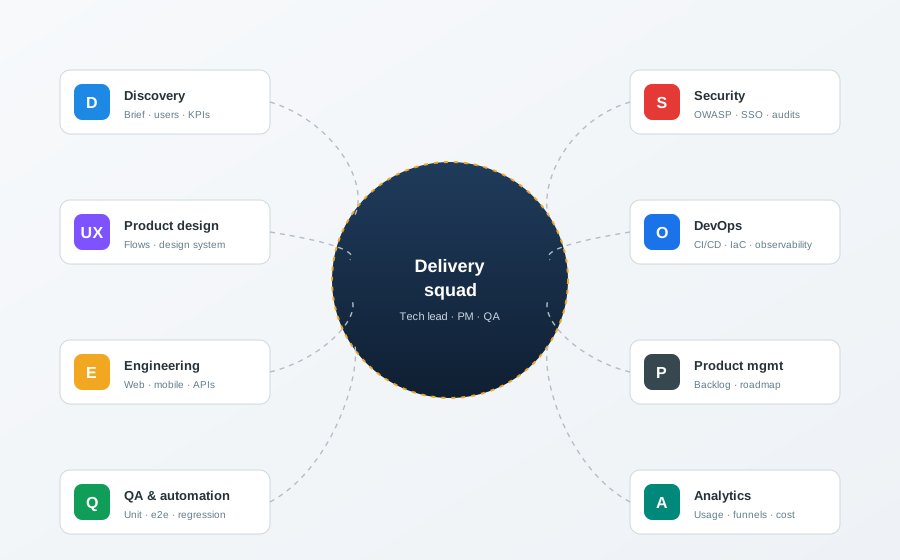
We are Siblings Software, a nearshore software outsourcing company based in Cordoba, Argentina. Clients come to us when a prototype has stalled, a first vendor has drifted off scope, or an internal team needs a product-ready squad without a six-month hiring cycle. We take the brief, write an estimate, staff a team and ship working software into your repositories, your cloud and your users’ hands.
This is our umbrella service page. It covers the full outsourced delivery model, from discovery to post-launch support, across web, mobile, backend, data and AI. If you already know you need a specific stack, jump straight to web development, mobile app development, back-end development or API development.
Who actually outsources software development to us
We have been doing this since 2015. The buyers who get the most value from a Siblings Software engagement tend to fall into four shapes. If you recognize yourself in any of them, outsourcing with a managed partner is usually a better bet than stitching contractors together.
Founders between MVP and Series B
You have a working prototype or a small v1 and you need to get to a production product before the next round closes. You do not have a VP of Engineering yet. You need a team that treats your codebase like it will outlive them, because it will.
Product-led scale-ups with a stretched engineering team
Your internal engineers are strong but oversubscribed. You have a stalled backlog item, a legacy service nobody wants to touch, or a platform migration that has slipped two quarters. You need a squad that absorbs a slice of the roadmap without draining your own leaders.
Enterprises with regulated delivery constraints
Banks, insurers, logistics operators and healthcare networks. You come with security questionnaires, audit logs and a legal team that reads every clause. We have worked inside those environments and we like them, because they make good engineering non-negotiable.
Non-tech brands that need a serious digital product
Retailers, media companies, professional services firms and manufacturers. Software is not your core business, but your customers or employees expect a native-feeling experience. We usually ship a fixed-scope build, hand it to a lightweight internal owner and stay on a thin retainer for incidents.
What software outsourcing actually means here
A delivery partner, not a body shop.
Software development outsourcing has a bad reputation for a reason. For years the industry defaulted to the same pattern: a sales team promises everything, a pool of juniors gets thrown at the code, and six months later the client owns a build nobody can reason about. That is the version we compete against, and it is not what we do.
An engagement with us always includes a named delivery lead who is accountable for the outcome, senior engineers as the core of the squad, a QA owner from day one, and a product-minded partner on our side whose job is to say “this will hurt you in six months” before it does. Juniors join when there is someone senior to pair with them, never as the cheap filler of a headcount spreadsheet.
Concretely, we write code the way you would write code if you had a disciplined internal team. That means typed languages where they pay off, automated tests at the seams that actually matter, OWASP Proactive Controls built into pull request reviews rather than bolted on at the end, CI/CD from the first commit, observability before production, and a README that a new developer can actually follow. We publish a lightweight internal playbook based on ThoughtWorks Technology Radar patterns so our teams drift toward the same engineering defaults.
The goal is simple: when you eventually hire an in-house lead, they open the codebase, read it, and are not horrified. We do not optimize for a slick demo at handover. We optimize for the first 90 days after we leave.
Engagement models and honest pricing
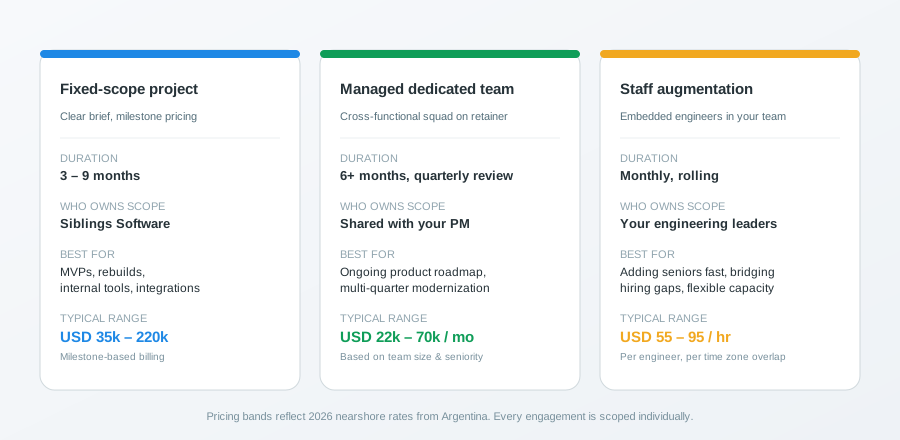
We work under three commercial models. The choice is not about preference, it is about who owns scope, how much the deliverable is defined, and how much flexibility you need month to month.
Fixed-scope project
You have a clear brief, or we write one during a short paid discovery. We quote a deliverable, a release window and a written change-control process. You pay in milestones tied to demos, not to calendar days. Typical range: USD 35,000 to 220,000 for a production MVP or rebuild with a reasonable set of integrations, analytics and a staged launch.
Best for: MVPs, rebuilds, internal tools, integration projects, regulated one-off builds.
Managed dedicated team
A multi-quarter retainer built around a delivery lead and a team sized to your roadmap. Scope is shared with your PM or product owner. Good fit when you plan at least two quarters of work, want the same people deep in your domain, or need a flexible pipeline instead of a fixed deliverable. Typical range: USD 22,000 to 70,000 per month depending on seniority mix.
Best for: ongoing product roadmaps, platform modernization, regulated enterprise backlogs.
Staff augmentation
We supply senior engineers who plug into your team, ceremonies and tracker. Your leaders own the work; we handle sourcing, onboarding, administration and bench backup. Typical range: USD 55 to 95 per hour depending on role and time zone overlap. Details and full process live in our staff augmentation page.
Best for: adding senior capacity quickly without full-time hires.
Note on pricing. We share ranges because we have seen buyers waste months because nobody would give them a number. These are the bands we actually quote in 2026, anchored in senior nearshore rates from Argentina. A precise estimate requires a short call and, for larger projects, a paid discovery sprint.
How an outsourced software project flows end to end
Every engagement, regardless of commercial model, follows the same seven-phase arc. The depth of each phase scales with scope, but none of them is ever skipped. The teams that skip discovery and architecture are the ones you eventually hire us to rescue.
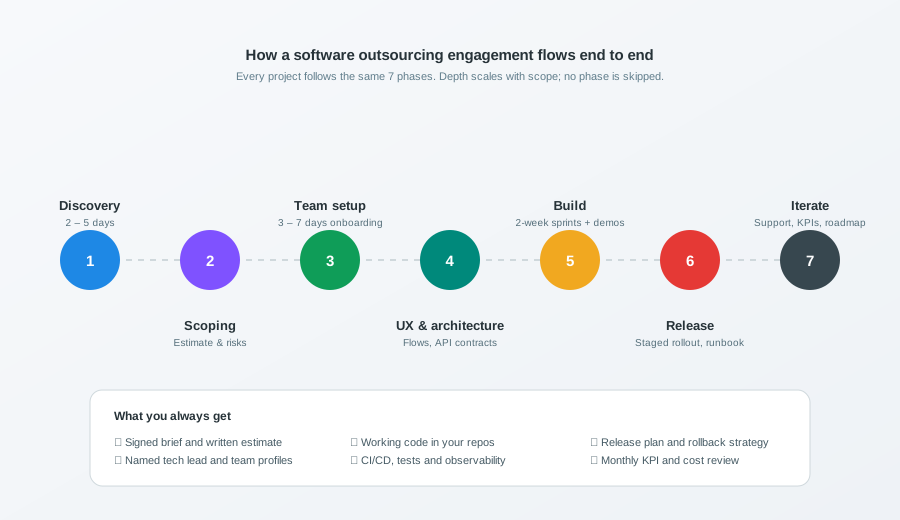
- Discovery. A focused 2 to 5 day engagement with product, design and engineering stakeholders. We map user flows, integration points, non-functional constraints and success metrics. The output is a written brief both sides sign.
- Scoping. A written estimate with assumptions, risks, an architecture sketch and a release plan. If you accept, the estimate becomes the baseline for change control.
- Team setup. We name the delivery lead, senior engineers and QA owner, share their profiles and set up access. You meet them. Onboarding is usually 3 to 7 working days.
- UX and architecture. We translate the brief into flows, component inventory, a design system, a data model and API contracts. This is where we push back if something will hurt later.
- Build. Two-week sprints with written goals, a mid-sprint check-in, a demo, a retrospective and a release candidate at the end. Every pull request is reviewed. Every merge runs the full test suite.
- Release. Staged rollout behind feature flags, monitoring dashboards and a rollback plan. We write the release notes. We keep the internal tester list small and honest.
- Iterate and support. 30 days of stabilization on fixed-scope engagements, or an ongoing cadence on retainers. We review KPIs monthly and propose what to work on next based on evidence, not opinion.
Realistic projects we outsource-deliver
A sample of the shapes of work that actually come through our pipeline. These are the scenarios we scope most weeks, across web, mobile and backend.
Custom SaaS platforms
Multi-tenant products with role-based access, billing, usage metering and an admin console. We usually pair a Next.js or React front end with a Node.js or Python backend and Postgres.
E-commerce and marketplaces
Storefronts with personalized home screens, complex carts, saved addresses, third-party payments, and headless commerce integrations. Often extended with AI-driven recommendations.
Fintech and regulated banking features
Onboarding flows with KYC, biometric login, tokenization, consent screens, audit trails and penetration-test remediation. We have sat through more ISO 27001 audits than we care to count and we know what matters on the day.
Mobile apps on Android and iOS
Native Android in Kotlin and native iOS in Swift when platform depth matters, cross-platform when business logic dominates. Detailed engineering standards live on our Android and Swift pages.
Data platforms and AI features
Pipelines from source systems to a warehouse, analytics dashboards, and targeted AI features built on retrieval-augmented generation or small agentic workflows. Deeper specifics in our AI development service page.
Platform modernization and takeovers
Existing systems we inherit from another vendor or a departed internal team. We start with a paid audit, stabilize the top 20 percent of issues that cause 80 percent of the pain, and rebuild modules incrementally behind feature flags.
A grounded case study: Binsensors partner portal
Binsensors, a logistics scale-up that monitors waste collection fleets across several European cities, approached us after their partner portal had missed two release dates in a row. The internal team was strong on hardware and firmware, weaker on the web stack. The codebase had been handed between contractors, test coverage was below 10 percent, and the operations team had stopped trusting the uptime numbers the portal reported.
We ran a two-week discovery, wrote a brief, and proposed a six-month managed dedicated team: one delivery lead, three senior full-stack engineers, one QA automation engineer and part-time DevOps. We took over the repository, shipped the existing backlog in its current shape for the first sprint to build trust, then began refactoring the telemetry ingest behind feature flags. We introduced contract tests against the device API, a staged rollout strategy and a proper SRE-style error budget.
By month four, onboarding time for new carriers dropped roughly 40 percent, release cadence moved from quarterly to weekly, and the operations dashboard finally matched the field reality. The full technical story is in our Binsensors case study.
Engagement snapshot
Model: managed dedicated team (6 months)
Team: 1 delivery lead, 3 senior full-stack devs, 1 QA, part-time DevOps
Stack: TypeScript, Next.js, Node.js, Postgres, AWS
Outcome: weekly releases restored, onboarding time down ~40%, telemetry trust restored
Outsourcing compared with freelancers, in-house and agencies
Most buyers are really choosing between four ways to get software built. Here is how we actually see the trade-offs, including where outsourcing is the wrong answer.
Freelancers
Lowest sticker price, highest variance. Works for a one-person experiment, a marketing microsite, or a limited-scope script. Falls over when you need code review, release hygiene, bus-factor resilience, or someone to answer when production breaks at 03:00.
Full in-house team
The correct long-term answer for any company where software is the product. Wrong short-term answer if you need to ship in six months, you do not yet have a CTO to hire and mentor, or your local market does not have the senior engineers you need at a price that works.
Traditional agencies
Good at launches and marketing sites, often weaker at long-term product engineering and operational ownership. If your question is “how do we keep improving this system for three years” rather than “how do we ship a launch”, an agency is usually the wrong shape.
Managed outsourcing (what we do)
We own delivery end to end while staying transparent enough that an internal leader can step in at any time. Best fit when you want a named team, a written scope, real engineering standards and a partner who will tell you when to stop spending. Wrong fit if you only want cheap hourly engineers with no oversight — that is what freelance platforms are for.
If you have an internal tech lead and just need senior engineers in your ceremonies, look at staff augmentation instead. If you want a time-boxed deliverable with us owning scope, see project-based outsourcing. If you want a multi-quarter team you effectively direct, see dedicated teams.
Risks and how we actually mitigate them
Outsourcing has real failure modes. The responsible thing is to name them and explain how we handle each one, rather than pretend that signing with us removes risk.
Scope drift and surprise invoices
We require a written brief before any fixed-scope quote, and every change goes through a lightweight change-control note with estimated effort. You see the burn weekly and you can stop at any sprint boundary with no exit penalty.
Key-person risk
Every engagement has at least two engineers with production knowledge of each critical area. Runbooks, architecture diagrams and a living README are part of the Definition of Done, not a handover artifact written in the last week.
Security and IP leakage
Mutual NDA, MSA with IP assignment on payment, SSO and least-privilege access into your cloud, and a written offboarding checklist. For regulated clients we align to ISO 27001 control families even when formal certification is not required.
Quality erosion over time
Code review is mandatory. Static analysis, dependency scanning and test coverage thresholds live in CI. We publish a short engineering health report each month: flaky tests, crash rates, response time percentiles, cloud cost trend. You see degradation before it becomes a fire.
What clients usually get wrong before talking to us
After roughly a decade of scoping calls, we see the same four mistakes. None of them are fatal, but noticing them early saves weeks.
- Treating outsourcing as a cost decision instead of a speed-and-focus decision. The buyers who save the most long-term money are the ones who optimize for predictable delivery, not the lowest hourly rate.
- Starting with a tech stack instead of a problem. “We want a Next.js app with Supabase” is a solution, not a brief. A 30-minute conversation about users and constraints usually changes the architecture.
- Underinvesting in the first two weeks. Skipping discovery to “save time” almost always costs a sprint or two later when assumptions collapse. The teams that run a real discovery ship faster.
- Believing that a detailed PDF spec replaces a delivery lead. Specs cannot argue with reality. A good delivery lead can. Outsourcing works when you pay for the judgement, not just the hands.
Why Argentina, practically
The short version. Argentina has a deep pool of senior engineers trained at strong public universities, a culture that takes debugging personally, and time zone overlap with the US that makes synchronous work feasible. On paper it ticks the boxes of most nearshore pitches.
The longer version that matters once you start working with us: Argentine engineers tend to push back on bad requirements instead of silently implementing them, which is the single feature we hear most in client feedback. It is annoying on day one and invaluable by month three. For deeper comparisons with other geographies, see our nearshore development page.
Frequently asked questions
Related services worth reading before a scoping call
If you already know the shape of the problem, these pages go deeper than an umbrella overview.
- Web development outsourcing — front-end and full-stack web builds.
- Mobile app outsourcing — native and cross-platform mobile.
- API development — REST, GraphQL and event-driven integrations.
- Back-end development — services, data and platform engineering.
- AI development — LLM features, RAG and agentic workflows.
- Staff augmentation — senior engineers embedded in your team.
- Dedicated development teams — multi-quarter managed squads.
Contact us
Tell us what you are trying to ship and what has stalled. We will come back with a written estimate or a recommendation to go somewhere else if we are not the right fit.