Swift & iOS staff augmentation
Hire Swift developers from Argentina without spending a quarter on the search
· Average time to first merged PR: 10 to 14 days
Finding a good iOS engineer in the US or the UK takes about eleven weeks on average, between the first opening and a signed offer. If your App Store release is sooner than that — or you already know you just need one extra pair of hands for the next six months — a permanent hire is the wrong instrument. A senior Swift engineer embedded through staff augmentation can be pushing code to your repo inside two weeks.
Siblings Software is a small Argentine firm that has been shipping iOS work since Swift 1. We place senior SwiftUI, UIKit and Vapor engineers inside existing product teams on a monthly model, with a full US business-day overlap and transparent pricing. This page is written for the person who has to make the decision: what the scope looks like, what it costs, how the fourteen-day onboarding actually works, and when we will tell you augmentation is the wrong answer for your brief.
Who actually hires Swift developers from us in 2026
Four buyer profiles account for almost all of our Swift staff augmentation engagements.
iOS teams racing a fixed Apple calendar
WWDC lands in June. Every year some of your roadmap depends on a new SDK, and every year you discover in April you are two engineers short. We drop in senior SwiftUI specialists who already know the current iOS release, pair with your leads on the new APIs, and disappear again after the post-launch stabilisation sprints.
Product companies with one iOS app and zero spare capacity
The app is two or three years old, a handful of internal engineers keep it alive, and nobody has time to pay down debt, migrate off UIKit, or fix the in-app purchase flow that Apple keeps flagging. Augmentation buys you a full-time owner for a bounded slice of the roadmap without the cost and risk of a permanent hire.
Fintech, healthtech and regulated industries needing compliance hands
HIPAA, PCI-DSS, PSD2, SOC 2 reviews and App Review rejections do not wait for the next hiring cycle. We bring iOS engineers who have shipped inside regulated environments: StoreKit 2, biometric auth, secure enclave usage, privacy manifests, and the parts of the App Review Guidelines that never make it into the docs.
Agencies and product studios with a Swift backlog they cannot staff
You sold iOS retainers that you now cannot staff without paying Bay Area salaries. White-labelled augmentation lets you keep the retainer, ship to your SLA, and bring our engineers into your Slack and your Linear. Clients see your brand. We stay in the background, do the work, and hand tickets back to your delivery lead.
If you are building a brand-new iOS product from zero and have no engineers at all yet, augmentation is not the right starting shape. For that, a dedicated Swift development team or a project-based engagement fits better. We will say so on the first call.
What an embedded Swift engineer actually ships each sprint
“We do iOS” is not useful when you are evaluating vendors. The scope below describes the work a senior Swift augmentation engineer typically owns inside a sprint. The mix shifts per engagement, but rarely are fewer than four of these areas in play at any given moment.
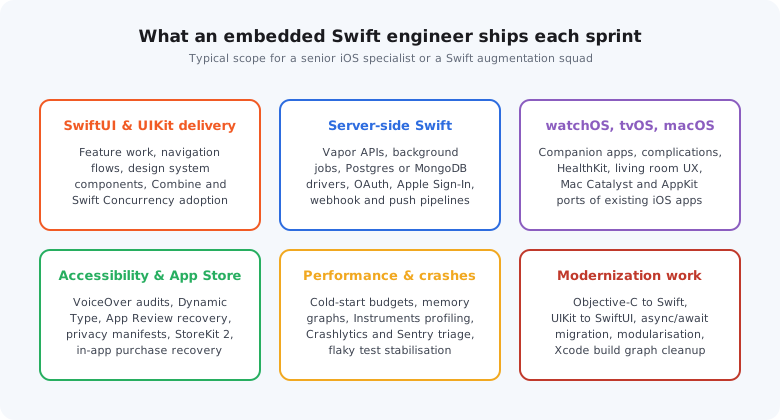
SwiftUI and UIKit feature delivery
Onboarding flows, monetisation screens, deep links, widgets, Siri intents, Live Activities, App Clips and the fiddly bits around iPad multitasking. We ship in your design system, not a parallel one, and we treat the component library as production software — documented, tested, and not forked just because something is hard.
Server-side Swift with Vapor
Vapor with Fluent, Postgres or MongoDB, Redis for queues and caches, proper async/await routes, webhook receivers, background jobs, Apple Sign-In and StoreKit server notifications. We avoid the trap of rewriting your Node or .NET backend just because we like Swift — Vapor earns its place when the team is already iOS-first.
watchOS, tvOS and macOS targets
Apple Watch complications, HealthKit integrations, glanceable widgets, Living Room UX on tvOS, and macOS ports via Catalyst or native AppKit. These are the targets that sit at the bottom of most iOS backlogs. We pick them up as bounded slices of work rather than another full-time hire nobody can justify.
Accessibility and App Store compliance
VoiceOver audits that pay attention to traits and not just labels, Dynamic Type support on real screens, colour-contrast regression checks, privacy manifests, App Tracking Transparency flows, and App Review recovery work when a release gets bounced. We do not write “accessibility-ready” code and hope; we ship with assistive tech turned on.
Performance, crashes and tests that actually run
Cold-start budgets per build, Instruments time profiling on real devices, memory graph diffs on every release, Crashlytics and Sentry triage inside the ops call, and rescuing XCUITest suites from the 70%-pass-rate graveyard that most teams learn to live with. Performance regressions fail the build the same way type errors do.
Modernization, without freezing the roadmap
Objective-C to Swift, UIKit to SwiftUI, Combine to Swift Concurrency, big monolithic Xcode projects to modularised Swift Packages. We work in thin, shippable slices; nobody signs off on a ten-week rewrite with nothing in production until week nine. The language reference is the official Swift book, and we stay close to the Apple developer documentation for platform APIs.
Every senior we place has shipped at least one production iOS app to the App Store, owned at least one major SDK migration (iOS 13 to 14, UIKit to SwiftUI, or equivalent), and carried at least one app through an App Review rejection cycle. Most have all three, across fintech, healthtech, retail and media.
Engagement models and what they cost per month
We publish ranges because hidden pricing wastes everyone’s time. The final number depends on seniority mix, English fluency (some buyers pay a premium for engineers comfortable facing their own stakeholders directly), and whether the brief needs a specialist — a StoreKit 2 lead, a VoiceOver-fluent accessibility engineer, or someone who has migrated three UIKit apps to SwiftUI already.
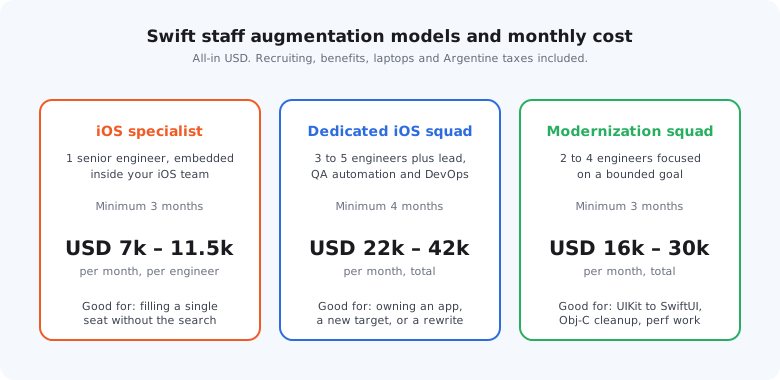
iOS specialist
One senior engineer embedded in your iOS team. Good when the engineering org is solid and you need one more pair of experienced hands that already knows SwiftUI, the current iOS version and the App Store submission pipeline. Pairs with your team on the hardest parts, owns one slice of the app, attends your stand-ups.
Price: USD 7,000 to 11,500 per month. Minimum: 3 months.
Dedicated iOS squad
Three to five engineers (senior and mid mix) with a tech lead, QA automation and part-time DevOps. Owns one product target end-to-end: a new app, a major rewrite, or a second iOS product that the core team does not have bandwidth for. For outright project ownership, pair with our Swift development team page.
Price: USD 22,000 to 42,000 per month. Minimum: 4 months.
Modernization squad
Two to four engineers on a bounded goal: UIKit to SwiftUI, Objective-C to Swift, a crash-rate intervention, or a StoreKit 2 migration. Runs alongside your feature team rather than instead of it. Hands back when the scorecard is green — we do not linger past the brief.
Price: USD 16,000 to 30,000 per month. Minimum: 3 months.
Numbers assume forty-hour weeks and include recruiting, benefits, laptops, paid time off and Argentine taxes. Third-party services — Firebase, Sentry, Datadog, BrowserStack, Fastlane hosting, Apple Developer Program fees — stay on your accounts so you keep control of data, billing and code-signing certificates.
The hiring process, end to end, in fourteen days
Long pipelines waste everyone’s time. We keep ours boring on purpose. Every step below is a deliverable, not a meeting; nobody sits in limbo waiting for a recruiter to come back.
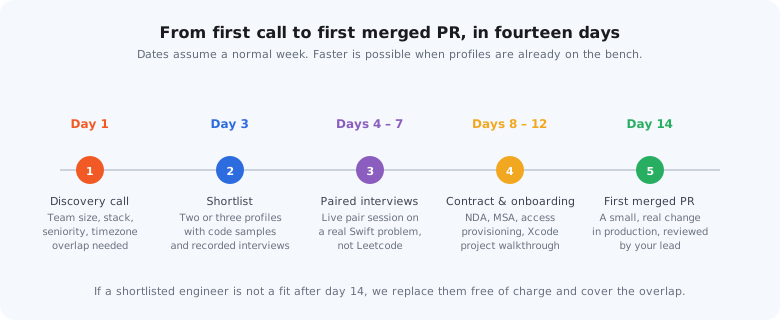
- Day 1 — Discovery call. Forty-five minutes with the account lead and a Swift tech lead. We ask about team size, current stack, seniority gaps, codebase quirks, release cadence and the amount of timezone overlap you actually need. You leave the call knowing whether we think the brief is a fit or not.
- Day 3 — Shortlist. Two or three Swift engineers with matched seniority and domain. You get a one-page profile per engineer, a public Git link where possible, a twenty-minute recorded technical interview, and a short write-up from the tech lead explaining why each profile fits your brief specifically.
- Days 4 to 7 — Paired interviews. A live ninety-minute pair session on a real Swift problem from our codebase (usually a SwiftUI state-management puzzle or a subtle Combine bug). No hidden Leetcode. Your lead sees how the engineer reads unfamiliar code, asks for context, and pushes back when the question is wrong.
- Days 8 to 12 — Contract and onboarding. NDA and MSA signed digitally. Access provisioning: GitHub or GitLab, your project management tool, Figma, TestFlight, Apple Developer Program. Xcode project walkthrough with a senior on your side. By day twelve the engineer has a local build, has run the test suite, and has triaged their first ticket.
- Day 14 — First merged PR. Small and real: a bug fix, a copy change with localisation, a minor UI tweak that lands in production. Reviewed by your engineering lead, shipped through your normal release pipeline, and measured. If the engineer cannot land this first PR cleanly, the free fourteen-day replacement window is on us.
Most engagements run to this rhythm. A small number — usually enterprise legal reviews on the customer side — extend the contract step to day twenty or so. We do not pretend otherwise on the first call.
Swift staff augmentation vs freelancer, in-house hire and generic offshore
Most prospects have already tried at least one of the alternatives below. Here is an honest comparison. If a row does not match what you have seen, say so on the first call and we will adjust the framing rather than pretend otherwise.
Where a freelance iOS developer wins
Scoped tasks with a clear definition of done. A single Core Bluetooth implementation. A one-off Siri intent. A StoreKit 2 migration inside a dormant app. If the work is under roughly eighty hours and well-defined, a specialist freelancer on Toptal or Arc is usually cheaper and faster than any agency.
Where a freelancer hurts
Continuity. Multiple concurrent clients, unannounced holidays, and almost zero appetite for the unglamorous work that keeps an iOS app healthy: SDK upgrades when Apple shifts the defaults, crash triage, flaky-test stabilisation, accessibility regressions, provisioning profile expiries. You ship tickets fast and the platform quietly rots.
Where an in-house Swift hire wins
Long-term ownership. If iOS is the core of your product for the next three years and you can afford a three-month search plus ramp, a full-time senior is irreplaceable. Plenty of our clients start with us, see what “good” looks like inside their stack, and then hire internally. That is a healthy outcome, not a loss.
Where in-house hurts
Cost and time-to-seat. A senior iOS engineer in San Francisco, Seattle or New York runs USD 210k to 290k total comp. The search averages eleven weeks. If the hire is wrong at month six, you are looking at severance and a second search while the roadmap stalls. For a six-month brief, augmentation is simply the right financial instrument.
Where large offshore agencies win
Warm bodies at low rates when the work is genuinely generic: CRUD screens, theme tweaks, minor SDK integrations. If the brief really is “give me ten iOS developers and assign them tickets,” big-five offshore firms are built for exactly that.
Where large offshore agencies hurt
The engineer in the interview is rarely the one in the commits. Timezone overlap with the US tends to be two to four hours. Accessibility, privacy manifests and App Review expertise are treated as extra scope. Notice periods are thirty to ninety days, which makes ramp-down painful when a project ends.
Where we fit in
Small, senior, full-time employees in a timezone that overlaps a full US business day. You interview the exact engineer who will work on your app. App Review, accessibility, performance budgets and modernization are part of the default scope rather than add-ons. Minimum commitments are three to four months, not a year. Notice is fifteen days either side.
If you need project ownership rather than augmentation, look at our full-service Swift development outsourcing. Same engineers, different commercial model.
Real Swift augmentation scenarios we see repeatedly
These are composites from recent engagements. Details are anonymised, numbers rounded, but the shapes are accurate. They are here because buyers usually want to know whether their situation is a thing we have dealt with before, not a novelty we are pitching.
Scenario A — the app rejected by App Review two weeks before launch
Context. US health and wellness startup. Submission three had come back with a Guideline 5.1.1(iii) rejection, a 2.1 metadata rejection, and an in-app purchase flow that was not honouring Apple’s receipt-sharing expectations. Internal team had never shipped a consumer app before.
What we did. One senior iOS engineer embedded for six weeks. Rewrote the permissions copy and onboarding flow, rebuilt the StoreKit 2 integration with proper transaction observers, fixed the account deletion path, and produced a written walkthrough for App Review.
Outcome. Submission four approved inside twenty-eight hours. App launched on the original Monday. The engineer stayed on for three more months to harden the subscription funnel.
Scenario B — the UIKit codebase the team refused to touch
Context. UK-based logistics SaaS, iOS app built in 2017 on UIKit and storyboards. Five internal engineers, all hired in the SwiftUI era, openly avoided the iOS ticket queue. Every minor change took a week because nobody had a mental model of the view hierarchy.
What we did. Two senior engineers for four months. Introduced a SwiftUI-UIKit bridge, migrated the three highest-traffic screens first, modularised the project into Swift Packages, and wrote a “where to start” ADR the internal team actually read. No storyboards remained after month three.
Outcome. Median time-to-ship on iOS tickets fell from seven to two days. Crash-free sessions rose from 98.4% to 99.7%. Two of the internal engineers started volunteering for iOS work again.
Scenario C — the Vapor API the Node team would not own
Context. Developer-tools startup, iOS-first client with a small Swift service sitting next to a larger Node platform. The Vapor backend powered push notifications, device attestation and Apple Sign-In. The Node team did not want to learn Swift; the iOS team could not cover the backend rota.
What we did. One senior Vapor specialist, three months. Tightened the async/await routes, moved background jobs to a Redis-backed queue, replaced a brittle receipt-validation path with Apple’s server API, and added runbooks the Node team could actually follow when paged.
Outcome. Push-notification latency dropped from a p99 of 4.6 seconds to 610 ms. The Vapor service reached zero Sev-1 incidents in the following quarter. On-call burden moved back inside the Node team with a three-page runbook instead of a phone call.
Scenario D — the product studio with a Swift backlog
Context. A Canadian product studio with seven live iOS retainers, all built between 2019 and 2023. Their senior iOS lead had left for a FAANG role. Juniors could not service the retainers alone and the studio was at risk of losing two accounts.
What we did. Two senior iOS engineers on a rolling staff-augmentation model for nine months. White-labelled on the studio’s Slack and Linear. Triaged the combined backlog, set up a weekly dependency-upgrade window across all seven apps, and ran two UIKit-to-SwiftUI slices as discrete sub-engagements.
Outcome. Backlog cleared in the first eight weeks. All seven retainers held through the engagement. The studio later hired one of our engineers full-time at month ten on a zero-fee conversion, because we had crossed the twelve-month mark on that specific engineer elsewhere.
Mini case study
How a fintech moved 62 UIKit screens to SwiftUI in 12 sprints, without freezing the roadmap
Client. A North American fintech scale-up preparing for a Series C announcement. The iOS wallet app had grown organically since 2019, had 62 UIKit screens with storyboards, and was starting to lose against a younger competitor on App Store rating and onboarding drop-off.
Brief. Migrate to SwiftUI, introduce Swift Concurrency, and ship a refreshed onboarding before the investor roadshow twelve sprints out. The internal iOS engineers were busy with PCI-DSS and PSD2 remediation and could not own the migration.
What we did. Three SwiftUI engineers, one Vapor engineer and one QA automation specialist, embedded for eight months. Week 1 produced a migration map: which screens were first (onboarding, balance, send), which were last (settings, legal), and which were not worth migrating at all (two rarely used admin screens). We introduced a small SwiftUI-UIKit bridge so both frameworks could coexist during the transition. The Vapor engineer ran a parallel track on Apple Pay Later server callbacks and a new Apple Sign-In path. QA automation moved the XCUITest suite from a 71% pass rate to 98% by quarantining and rewriting the flakiest thirty tests. Networking moved to async/await; legacy callback-based flows were shimmed until the screens that used them had migrated. We shipped every two weeks, not at the end.
Result. All 62 targeted screens migrated by sprint 12. App Store rating rose from 3.6 to 4.7 within three months of the refreshed onboarding. Active-user retention improved by 24% post-refresh, measured against the prior cohort. API-call latency dropped by 38% thanks to async/await and response caching. Zero Sev-1 incidents during the investor roadshow window. The internal team took ownership at month seven; we stayed for one day a week in month eight to handle tail-end issues.
Honest caveat. Sprints 1 and 2 felt slow from the outside because the migration map, the bridge, and the test suite rescue did not produce demo-able features. The VP of Engineering asked twice whether the pace was right. By sprint 4 the velocity curve flipped. If you compare features-shipped in month one, this engagement looks worse than a pure feature squad — that is an expected property of migration work, not a failure mode.
At a glance
Industry: Consumer fintech, US & Canada
Engagement: 5-person squad, 8 months
Stack: UIKit → SwiftUI, Vapor, Apple Pay Later, StoreKit 2
Screens migrated: 62 in 12 sprints
App Store rating: 3.6 → 4.7
Retention uplift: +24%
API latency: -38%
“The Siblings team hit our internal velocity by the second sprint. They owned the SwiftUI migration, kept telemetry clean, and coached our own engineers on structured concurrency without making a thing of it.”
VP of Engineering, fintech client
The risks of Swift staff augmentation, and how we actually handle them
Any vendor claiming Swift augmentation is risk-free is either inexperienced or selling. Here are the four failure modes we see most often, and the specific controls we use against each one.
Risk: the engineer looks strong on paper and stalls in week three
How we handle it. Vetting ends in a live pair session on a real Swift problem from our own codebase, not a Leetcode puzzle. Two-week free replacement window. On day 14 the account lead asks your engineering lead one question: “if this were a full-time hire, would you keep them?” In the last 18 months we have swapped two engineers on Swift engagements, both inside the free window.
Risk: App Store releases slip because of a provisioning or code-signing mess
How we handle it. Fastlane match or an equivalent approach is non-negotiable by week two. Certificates, profiles and capability IDs are documented in your team’s runbook, not stored in a senior engineer’s memory. The release dry run happens in the sprint before release, not the day of. Xcode Cloud or Bitrise pipelines are owned code, not unwritten tribal knowledge.
Risk: knowledge walks out when the engagement ends
How we handle it. Documentation is a line item, not a favour. Architecture Decision Records for non-obvious choices (why SwiftUI here, why still UIKit there, why a custom Combine operator), READMEs for every Swift package we introduce, runbooks for deploy, rollback and hotfix flows. If you end the engagement tomorrow, your internal team has a map, not a scavenger hunt.
Risk: crash rates or cold-start drift quietly after the “big push”
How we handle it. Per-template cold-start and LCP-equivalent budgets wired into CI. A budget failure blocks merges the same way a type error would. Crash-free-session and ANR numbers are reviewed in the weekly ops call alongside engineering progress, so performance regressions get triaged by the same people who ship features, not by a separate reliability team quarterly.
Why Siblings Software specifically
Decide based on facts, not slogans.
11+
Years shipping iOS apps
Founded 2014 in Córdoba, Argentina
60+
Swift engagements delivered
Fintech, healthtech, retail, media
GMT-3
Argentina timezone
Full same-day overlap with US Eastern
We are deliberately small. There is no sales organisation chasing headcount. Javier Uanini still takes most discovery calls personally and reviews every Swift engagement with the tech lead assigned. Our engineers talk to clients directly from week one. That is the actual reason onboarding is fast: there is nobody in the middle translating requirements.
Things buyers usually get wrong when shopping for Swift augmentation: asking for an hourly rate before explaining the work (you will be quoted the lowest possible number, and the real cost will arrive as change orders later), assuming any senior developer can pick up Swift in a week (Swift Concurrency, the view-lifecycle model in SwiftUI, and the App Store submission pipeline each take longer than that), and believing a bigger agency means more reliable delivery (in iOS specifically, small and senior beats large and generic almost every time, because Apple’s tooling rewards people who have lived inside it).
If you want to compare with adjacent stacks we also staff, see our pages for Objective-C developers, React Native developers and Flutter developers. For full product ownership rather than augmentation, our mobile app development service is usually the better fit.
Frequently asked questions from buyers
Our standards
Swift engagements run like production software, not a staffing spreadsheet.
- Cold-start and crash rates are budgets, not side effects. Budgets per build are wired into CI. A blown budget blocks merges the same way a failing test would.
- Certificates and provisioning are code. Fastlane match or an equivalent by week two. No “one senior knows the password” dependencies.
- Pull requests are reviewed by your lead. Our engineers are embedded in your process, not reviewing each other in a parallel bubble.
- Accessibility is turned on when we test. VoiceOver, Dynamic Type and colour-contrast checks happen on real devices, not by reading the WCAG docs once.
- Telemetry matches the feature. A new screen ships with its analytics events, its crash-free KPI, and its Sentry breadcrumb plan from the first commit.
- Written artefacts. Architecture Decision Records for non-obvious choices, READMEs per Swift package, runbooks for deploy, rollback and hotfix. Handover is a file tree, not a call.
Looking to compare with the US entity? See the US version of this page.
Talk to Siblings Software about Swift developers
Tell us about the app, the team and the target release. We reply within one business day, or say so on the first call if we are the wrong fit.