Ruby staff augmentation
Hire senior Ruby developers your team can actually work with
· Average time to first merged PR: 12 to 15 days
Most “hire Ruby developers” pages stop at a logo wall, a buzzword list and a contact form. This one is written for the three questions we actually get on discovery calls: what exactly will the engineer do in my repo, what does it cost a month, and how do I not end up with a freelancer who disappears for two weeks in August.
Siblings Software is a small Argentine firm. We staff Ruby product teams with senior engineers who have shipped Rails, Sinatra, Grape, Sidekiq and the odd Thor CLI in production for over a decade. We also say no when we are not the right fit, which does not happen on many staff augmentation websites.
Who actually hires Ruby engineers from us
Four buyer shapes cover most of the Ruby staff augmentation calls we take.
Rails product teams with a hiring funnel that stopped working
A Rails 6 or 7 application, four to ten internal engineers, two open Ruby requisitions that have been open for five months. The CTO wants to stop losing quarters to recruiting and start shipping. Staff augmentation is the stopgap and, quietly, often the long-term answer too.
Scale-ups moving pieces off the Rails monolith
The monolith is fine for 80% of the app, but the billing service needs its own life and the webhook ingestion layer is keeping someone up at night. You need engineers who can carve out a Sinatra or Grape service, wire it to Sidekiq, and not pretend this is a full rewrite.
Founders who inherited a Ruby codebase they did not write
The acquisition closed three months ago. There is a Rails app, a handful of cron scripts nobody has opened since 2022, a dashboard gem someone wrote in 2019, and the original developer is unreachable. You want someone who can read old Ruby calmly and tell you which parts are fine and which have to be replaced before they cost you a customer.
Teams whose Ruby work sits around Ruby, not inside Rails
Internal tooling, data pipelines, a Thor-based deployment CLI, a Grape API that sits in front of a Go service, a Ruby library wrapping a vendor SDK. The Rails hiring pool rarely covers this well. You want engineers who think in the language, not in the framework.
If none of those look like your situation, the discovery call is still free, and we will tell you in the first fifteen minutes if we are the wrong choice.
What a Ruby engineer actually does on your team
“Senior Ruby developer” is a vague title. The scope below is what one of our engineers realistically spends their week on once they are embedded. Not all six areas apply to every engagement. Most clients see four of them within the first quarter.
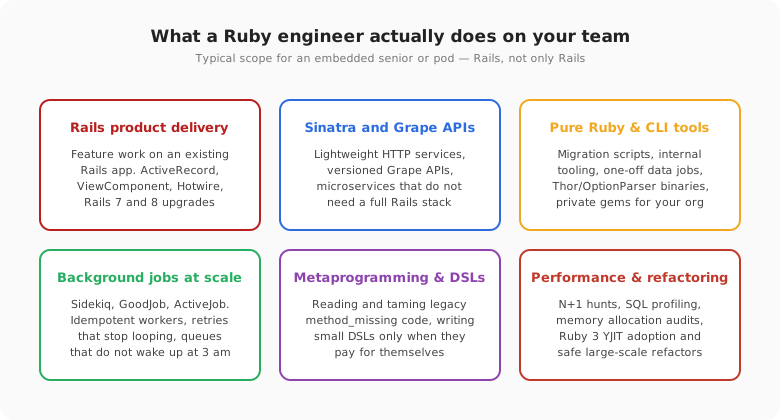
Rails product delivery, without rewrite fantasies
Feature work on an existing Rails codebase — ActiveRecord, ActionController, ViewComponent or a Hotwire front end when it fits. Rails 6 to 7 and 7 to 8 upgrades, concurrent-safe callbacks, responsible use of concerns, and enough discipline to not reach for a gem when a twenty-line service object will do. We also help teams navigate the official Rails Guides in code review rather than via stale blog posts.
Sinatra and Grape services
When the job is an HTTP endpoint that does two things and has to boot fast, Sinatra is still a good answer. For versioned JSON APIs consumed by multiple clients, Grape keeps the surface clean. Our engineers pick the framework that suits the job rather than reaching for Rails by reflex.
Pure Ruby tooling that belongs to your org
Internal CLIs built with Thor or OptionParser, one-shot data-migration scripts, private gems for shared code across repositories, Rake tasks that are actually readable. Ruby is an excellent scripting language. We treat these as first-class work and not as “glue code” nobody owns.
Background jobs that do not page at 3 am
Sidekiq, GoodJob and ActiveJob, with idempotent worker design, bounded retries, and queues that reflect business priority rather than alphabetical order. Dead-letter handling, middleware for tracing, and the boring but critical part: tests that catch the jobs that only fail in production when a third-party API is slow.
Metaprogramming, used sparingly
Ruby rewards metaprogramming and punishes it later. Our engineers can read method_missing, define_method and class_eval without flinching, but they reach for them only when a plainer alternative costs more over a year. Most teams need help taming old metaprogramming, not writing more of it.
Performance and safe refactoring
N+1 hunts with bullet and pg_query, allocation audits with memory_profiler, slow-endpoint work with Skylight or Datadog APM. Ruby 3.x YJIT adoption where it actually helps, and large-scale refactors driven by tests rather than hope. If your team has been afraid to touch a file, that file is usually where we start.
Every senior we place has shipped at least one Ruby codebase over five years old to production. Most have been through a Rails major upgrade, a Sidekiq incident they still remember, and at least one file they asked a teammate not to look at.
Engagement models and what they cost
We publish ranges because hidden pricing wastes everyone’s time. The number inside the range depends on seniority, English fluency (some clients pay a premium for engineers who talk to stakeholders directly without a project manager in the middle), and rare specialities like Sidekiq Enterprise, Rails Engine authorship or Ruby 3 Ractor experience.
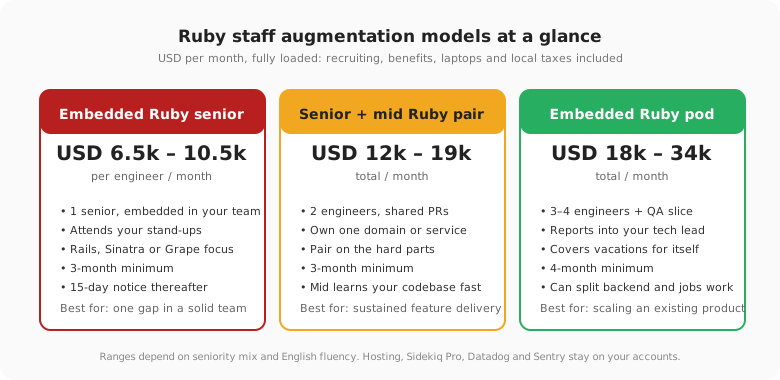
Embedded Ruby senior
One senior engineer inside your team. Good when your engineering org is healthy and you need one more pair of hands who already knows idiomatic Ruby, Rails conventions, and the parts of the gem ecosystem worth trusting. They attend your stand-ups, review your code, and pair with whoever is stuck.
Price: USD 6,500 to 10,500 per month. Minimum: 3 months.
Senior + mid Ruby pair
A senior and a strong mid-level working together. The senior sets the bar, the mid-level absorbs context quickly and takes the routine tickets off the senior’s plate by week four. Works well when a sustained delivery stream matters more than raw specialism. Pairs naturally with our Ruby on Rails staff augmentation option when Rails is the dominant stack.
Price: USD 12,000 to 19,000 per month. Minimum: 3 months.
Embedded Ruby pod
Three or four engineers with a QA slice. Covers vacations internally and can split between Rails feature work and a background-jobs or Grape service concurrently. Reports into your tech lead or engineering manager, not into a remote project manager. If you need full ownership instead, our dedicated Ruby on Rails team page is closer to that shape.
Price: USD 18,000 to 34,000 per month. Minimum: 4 months.
Numbers assume 40-hour weeks and include recruiting, benefits, laptops and local taxes. Hosting and infra (Heroku, Render, AWS, Fly.io), Sidekiq Pro or Enterprise, Datadog, Sentry and New Relic stay on your accounts so you keep data custody and control of billing.
How hiring a Ruby engineer through us actually works
Staff augmentation is not a marketplace. You are not scrolling a list of CVs. We run a short, practical process that ends with you interviewing the actual engineer who will write your code.
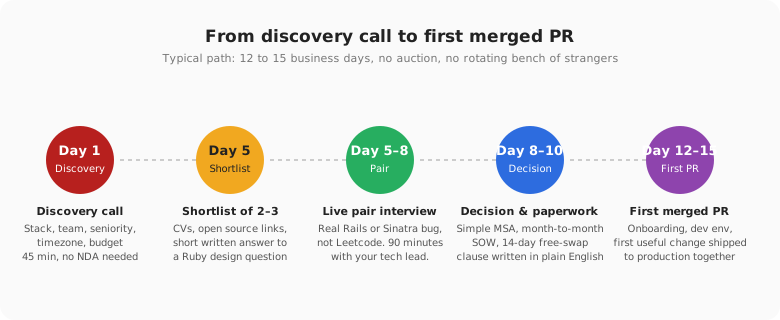
- Discovery call (day 1). 45 minutes. Stack, team size, seniority you actually need, timezone overlap, budget range, anything that is a hard no. No NDA needed. We will say if we are not a fit before the call ends.
- Shortlist of two or three (by day 5). We pull from our current bench and, if needed, from engineers in 30-day notice at other firms we have worked with for years. You get CVs, open-source links where they exist, and a short written answer to a Ruby design question so you see how they think before the interview.
- Live pair interview on real Ruby code (day 5 to 8). 90 minutes with your tech lead. We bring a sanitised slice of real Ruby work: a Sidekiq job with a retry bug, a Rails controller with a N+1, a Grape API with a serialisation problem. Candidates pair with you, not with a whiteboard. No take-home, no Leetcode.
- Decision and paperwork (day 8 to 10). Short master service agreement, a monthly statement of work, and a 14-day free-swap clause in plain English. Month-to-month with 15-day notice after the minimum term.
- First merged PR (day 12 to 15). Onboarding: accounts, dev environment, pairing on the first ticket. The goal is a small, useful change shipped to production in week two, so you know the engineer can read the codebase and land a PR, not just pass an interview.
If you have already done some of the vetting yourself — for example, you want to bring in a specific engineer you met at a conference and have us employ them — we can skip the shortlist step and compress the middle to 5 to 7 days. We call this an employer-of-record path and charge a smaller margin.
Ruby with us vs freelancer, in-house hire or generic offshore
Almost every client we talk to has already tried at least one alternative. Pretending those do not exist is lazy. Here is where each option actually wins, and where it usually costs more than the invoice suggests.
Where a freelance Ruby developer wins
Narrow, scoped work under roughly 80 hours. A Rails 6 to 7 upgrade on a small codebase. A Sidekiq deadlock reproduction and fix. A one-off CSV import script that will be thrown away. If the boundaries are clear, a good freelancer is cheaper and faster than any staff augmentation model.
Where a freelancer hurts
Continuity. They juggle three or four other clients, take holidays without warning, and rarely do the unglamorous work that keeps a Ruby codebase healthy: gem audits, Ruby 3 upgrade prep, Sidekiq queue reshaping, RuboCop debt triage. You ship tickets, the platform rots quietly in the background.
Where a full-time in-house hire wins
Long-term ownership. If Ruby is the centre of your product for the next five years and you can afford a three- to four-month search, a senior in-house engineer is irreplaceable. Plenty of our clients start with us, see what “good” looks like in their own repo, and then hire internally. We consider that a healthy outcome.
Where in-house hurts
Funnel risk and regret cost. Senior Ruby engineers in the US and UK take three to four months to close with high offer-rejection rates. If the hire is wrong at month six, you are looking at severance, not notice. Meanwhile the backlog grows and the CTO stops looking at Jira.
Where large offshore agencies win
Warm bodies at low rates for work that is genuinely generic and well specified: internal CRUD tools, an admin back office with 40 Rails scaffolds, a data-entry app. If the brief really is “give me ten Ruby developers and assign them tickets”, the large agencies are built for it.
Where large offshore agencies hurt
The engineer you interviewed is rarely the one committing. Timezone overlap with the US often shrinks to two or three hours. Work that goes beyond Rails — Sinatra microservices, metaprogramming audits, Ruby 3 Ractor experiments — gets treated as extra scope rather than the baseline. Notice periods of 30 to 90 days make winding down painful.
Where we fit
Between the two. Small, senior, full-time employees in one timezone with full US Eastern overlap. You interview the exact engineer who will write your code. Ruby outside Rails is default scope, not an upsell. Minimums are three to four months, not a year, and notice is 15 days.
If the Ruby work is 100% Rails product delivery, the Ruby on Rails staff augmentation page is a better starting point. If you need a full outsourced team rather than augmentation, see Ruby development outsourcing.
Real Ruby scenarios we see over and over
These are composites from recent engagements. Names and details are anonymised, numbers rounded, but the shapes are accurate. We include them because buyers almost always want to know if their situation is something we have dealt with before.
Scenario A — the Rails monolith that could not finish Rails 7
Context. A US marketplace, 420,000 lines of Ruby, stuck on Rails 6.1 for 14 months. Two senior engineers had tried and given up, blocked by a bespoke attachments library and a YAML-based permissions DSL from 2018.
What we did. One senior embedded for four months. Dual-boot set-up to run Rails 6.1 and 7.1 branches side by side. Rewrote the attachments wrapper around ActiveStorage. Replaced the permissions DSL with Pundit plus a thin policy generator. Upgrade PR merged in week 11, with 1,400 tests green.
Outcome. Rails 7.1 in production with no rollback. Boot time down 19%. The internal team was back to shipping features by week 13. The engineer stayed for another six months to do the Rails 8 preparation work.
Scenario B — the Sidekiq queue that melted on Mondays
Context. A UK SaaS with a long-running Sidekiq fleet. Monday morning batch ingest saturated Redis, jobs retried forever, the paging rotation spent two hours every Monday firefighting the same dashboards.
What we did. A senior engineer for six weeks. Split queues by priority rather than by team, added an explicit concurrency cap per worker class, replaced “retry until it works” with a dead-letter queue and an operator runbook, and introduced sidekiq-throttled where external APIs were the real bottleneck.
Outcome. Monday incidents dropped from four a month to zero for the next two quarters. Redis memory usage under peak load came down 38%. The runbook became the template for two other queues the team later migrated.
Scenario C — the Grape API that replaced a Rails-in-Rails service
Context. A Canadian fintech had a Rails Engine mounted inside a parent Rails app to serve a partner API. Boot time, deploy blast radius and auth tangles were all suffering. Leadership wanted a clean separation without “microservices all the way down”.
What we did. Two engineers for three months. Built a standalone Grape service, migrated endpoints in four batches behind a feature flag in the parent app, reused ActiveRecord models via a shared private gem, moved auth to a single JWT boundary. Tests ran in both suites until every endpoint flipped.
Outcome. Parent-app deploy time fell by roughly half. Partner API p95 dropped from 420ms to 180ms. The parent Rails engine was retired at month four and the standalone Grape service became the template for three more.
Scenario D — inherited codebase after acquisition
Context. A European scale-up acquired a smaller competitor with a five-year-old Rails app and zero internal Ruby expertise. The goal was not to rewrite, but to understand what could be safely merged into the main platform and what had to be quarantined.
What we did. One senior for eight weeks. Produced a module-level risk map: what was still on old Ruby but fine, what used metaprogramming in a way that blocked upgrades, where tests were theatre and where they were load-bearing. Wrote four architecture decision records and killed two gems that had not been maintained since 2020.
Outcome. The CTO had a real map within two months and a credible integration plan by month three. We recommended keeping two systems separate for at least another year — and put that in writing even though it shortened our own engagement.
Mini case study
How a health-tech Rails platform cut checkout errors by 71% with one embedded Ruby senior
Client. A US health-tech company running a patient-facing Rails 7 app plus a Sinatra-based partner webhook receiver. Roughly 260,000 lines, an internal team of seven. Checkout flow errors had been creeping up for five months; the team suspected the Sidekiq retry policy on payment-confirmation jobs but could not prove it without pausing feature work.
Brief. Embed one senior Ruby engineer, keep the product roadmap moving, and stop the checkout-error trend before the quarterly review.
What we did. The engineer joined in week two, spent the first ten days mapping the Sidekiq jobs that touched the checkout flow, then instrumented the payment-confirmation worker with structured logs and a trace id that flowed end-to-end from the Stripe webhook through the Sinatra receiver into the Rails Sidekiq queue. Root cause turned out to be three-layered: a race condition in an ActiveRecord lock, a Sidekiq retry backoff that re-charged cards that had already succeeded, and a Sinatra handler that was swallowing an exception class it should have surfaced. Fixes were shipped in three separate PRs between weeks 4 and 7, each with a targeted test. The engineer also pulled a quiet cleanup pass on the Payment model that cut 180 lines of dead metaprogramming nobody had wanted to touch.
Result after four months. Checkout errors fell 71% from the week 1 baseline. Duplicate-charge incidents — the previously most expensive category for support — dropped to zero for twelve consecutive weeks. Median Sidekiq queue depth on the payments queue fell by around two-thirds. The internal team kept shipping features throughout; in the retro, the head of engineering said the biggest win was not the numbers but that the on-call rotation stopped dreading Sunday nights.
Honest caveat. The first two weeks produced nothing demo-able. The engineer wrote instrumentation, read code, asked a lot of questions in Slack. If you compare output week-on-week against a feature-focused freelancer, we looked slow. By week six the compounding was obvious. If your buyer internally cannot hold that line for a month, an embedded engagement is the wrong shape.
At a glance
Industry: Health-tech / patient app
Engagement: 1 senior, 4 months + extension
Stack: Rails 7, Sinatra, Sidekiq, Stripe, Postgres, Datadog
Checkout errors: −71%
Duplicate-charge incidents: 0 for 12 weeks
Time to first merged PR: 11 days
The risks of Ruby staff augmentation, and how we handle them
Any vendor who tells you staff augmentation is risk-free is either new at this or hoping you are. Four failure modes cover most of the bad outcomes we have seen (including a couple we have personally produced and had to fix). Here are the specific controls we use against each.
Risk: the engineer looks strong in interview and stalls in week three
How we handle it. Vetting ends in a live pair session on real Ruby code — a Sidekiq job that looks right and is not, a Rails controller with a subtle N+1, a Grape entity that fails in only one environment. Not Leetcode. A 14-day free-swap window, and the account lead asks your tech lead one question on day 14: “if this engineer were a full-time hire, would you keep them?” In the last 18 months we have swapped two engineers, both inside the free window.
Risk: the engineer gets isolated and becomes a contractor in practice
How we handle it. We insist on basic integration: our engineer is in your Slack, on your stand-ups, reviewing PRs from your team and not only having theirs reviewed. We refuse engagements that ask for a “side lane” where our engineer ships to their own branch forever. Staff augmentation that does not integrate is freelancing with more paperwork, and we do not pretend otherwise.
Risk: knowledge walks out of the door at the end of the engagement
How we handle it. Documentation is a line item, not a favour. Architecture decision records for the non-obvious calls, README files for anything we introduce, runbooks for any job we rewrite, and a handover doc at the three-month mark that your next hire could open and understand. If you end the engagement tomorrow, the internal team has a map and not a scavenger hunt.
Risk: scope creep, or vanity work that does not move numbers
How we handle it. A monthly scorecard with three to five metrics that matter to your product — error rate, p95 latency on the endpoint that pays the bills, queue depth, background job failure rate, feature lead time. Those numbers sit in the monthly review so that engineering progress is visible to the people who do not read pull requests. Work that does not move them eventually gets killed.
Why Siblings Software specifically
Decide on facts, not slogans.
11+
Years staffing Ruby teams
Founded 2014 in Córdoba, Argentina
80+
Ruby engagements shipped
Rails, Sinatra, Grape, Sidekiq, across fintech, health, retail, logistics and media
GMT-3
Argentina timezone
Full same-day overlap with US Eastern and most US hours
We are deliberately small. There is no sales organisation chasing headcount. The founders — Javier Uanini still takes most discovery calls personally — review every engagement. Our engineers talk to clients directly from week one. That is the real reason onboarding is fast: there is nobody in the middle paraphrasing requirements badly.
Things buyers usually get wrong when shopping for Ruby staff augmentation: asking for an hourly rate before scoping the work (you will be quoted a flattering low number, and the real cost arrives as change orders later), assuming that any Ruby engineer with a Rails CV has serious metaprogramming, Sidekiq-at-scale or Ruby 3 performance experience (most do not), and believing that a bigger agency means safer delivery (in Ruby product work, a small senior pod outperforms a large generic bench roughly every time).
For language reference, we point new engineers at the official Ruby language site before anything else, and the RubyGems directory is the first place we check before adopting a dependency. We read the Ruby NEWS for each minor release and we do not treat Ruby as the language that happens to be underneath Rails.
Frequently asked questions from buyers
Our standards for Ruby work
Ruby treated as a first-class language, not a convenience on top of Rails.
- Idiomatic over clever. Small service objects before big concerns. Explicit before magical. Metaprogramming only where it earns its keep.
- Tests that carry weight. RSpec or Minitest with real assertions, not
expect(subject).to be_truthytheatre. System tests for the two or three flows that actually pay the bills. - Sidekiq that behaves. Idempotent jobs, bounded retries, dead-letter queues, observability from day one. No “just restart the worker” advice in runbooks.
- Gem hygiene. Dependabot or Renovate turned on. No gems unmaintained for 24 months in the critical path without a written reason.
- RuboCop and Brakeman as CI gates. Style arguments are settled in config and forgotten. Security lint blocks merges.
- Written artefacts. Architecture decision records for non-obvious calls, READMEs per non-trivial module, runbooks for any job we own.
- Honest escalation. If the plan slips, it says so in the weekly update, not three sprints later when the quarterly review is due.
Talk to Siblings Software
Tell us about the Ruby codebase, the team and what you actually need. We reply within one business day, or say so if we are the wrong fit.