MCP Development Company in Argentina
We are a Model Context Protocol (MCP) software development company based in Argentina. We design, build and deploy custom MCP servers, AI-to-tool integrations and enterprise-grade MCP infrastructure that lets your AI applications communicate with any data source, API or business tool through a single standardized protocol.
In April 2026, MCP has become the universal standard for connecting AI models to external systems. With 97 million monthly SDK downloads and backing from Anthropic, OpenAI, Google DeepMind and Microsoft, the protocol is now the backbone of production AI integrations worldwide. The recently released MCP v2 Beta introduced OAuth 2.0 authentication, multi-agent support and structured output schemas, making it production-ready for enterprise deployments. Our team of experienced AI engineers builds custom MCP solutions that go beyond off-the-shelf connectors, tailored to your specific architecture and business requirements.
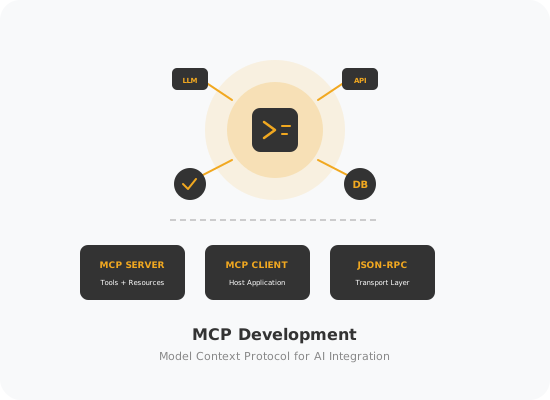
MCP Development Services
We build the bridge between your AI models and your business data.
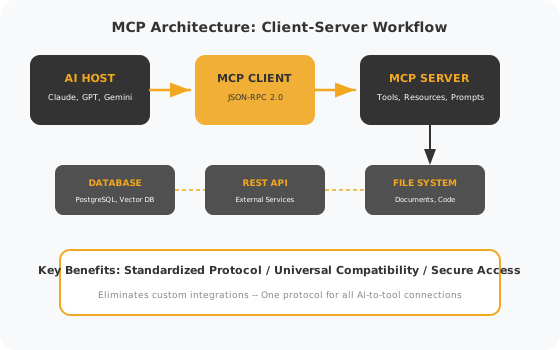
Before MCP, connecting an AI model to a database, a CRM or an internal API required writing custom integration code for each combination. Every new tool meant another bespoke connector, and maintaining dozens of these integrations consumed engineering resources that should have been spent building features. MCP eliminates this problem entirely. As the industry's open standard for AI-tool connectivity, it provides a universal protocol that any AI host (Claude, GPT, Gemini, open-source models) can use to interact with any MCP-compatible server. One protocol, infinite connections. We specialize in building production-grade MCP infrastructure that gives your AI systems access to the tools and data they need to deliver real business value.
Custom MCP
Server Development
We build bespoke MCP servers that expose your internal tools, databases and APIs as standardized resources that any AI model can access. Each server is built with the official MCP SDKs (Python or TypeScript), includes proper error handling, rate limiting, authentication and comprehensive logging for production environments.
Enterprise MCP
Integration Architecture
We design and implement complete MCP infrastructure for enterprise environments, including multi-server orchestration, OAuth 2.0 security layers, Streamable HTTP transport for cloud deployments, and integration with your existing identity providers, monitoring stacks and compliance frameworks.
Multi-Agent
MCP Systems
With MCP v2's support for multi-agent communication, we build systems where multiple AI agents collaborate through shared MCP servers. This enables complex workflows like automated code review pipelines, multi-step data processing and autonomous business process orchestration.
How We Implement MCP Solutions
A structured approach to connecting your AI systems with your business data.
Implementing MCP starts with understanding what your AI applications need to access and why. We begin with a thorough audit of your existing data sources, APIs and internal tools, mapping out which connections will deliver the most value. The first phase typically focuses on the highest-impact integrations: connecting your AI assistants to your production database, CRM or knowledge base through secure MCP servers.
From there, we expand the MCP ecosystem incrementally. Each new server follows a standardized development process: define the tool and resource specifications, implement the server logic, add security layers (OAuth 2.0, API key management, role-based access), write comprehensive tests and deploy with monitoring. We use Streamable HTTP transport for cloud deployments and stdio for local development tools, choosing the right transport layer based on your infrastructure requirements. Every integration is validated against real usage patterns before going live.
Ready to give your AI applications access to your business data?
If you need to build MCP integrations for your AI systems, we can help. We also offer general AI development, AI agents development and Python development services.
MCP Technologies and Ecosystem
The MCP ecosystem is growing rapidly. With over 5,800 available MCP servers and SDKs in Python, TypeScript and more languages being added, the tooling has matured beyond early-adopter stage into production-ready infrastructure. We stay current with every protocol update, including the MCP v2 Beta released in March 2026, and we recommend technologies based on real deployment experience, not just documentation.
Python / TypeScript SDKs
JSON-RPC 2.0 / Streamable HTTP
OAuth 2.0 / API Key Auth
PostgreSQL / Vector Databases
AWS / GCP / Azure
Claude / GPT / Gemini / Open-source
We build MCP servers that integrate with React and Next.js front-ends, backend systems in Node.js and Python, and connect them to AI agent workflows for end-to-end intelligent automation.
If you need to build MCP servers or integrate the Model Context Protocol into your AI stack, we can help.
Your AI should talk to your data, not just to your users.
Case Study: MCP Integration Platform for a HealthTech Company in Buenos Aires
One of the most complex MCP projects our team has delivered involved building a complete Model Context Protocol infrastructure for a HealthTech company headquartered in Buenos Aires that manages electronic health records for over 400 clinics across Argentina and Chile. Their medical staff relied on an AI assistant built with Claude to help with patient summaries, treatment history lookups and administrative tasks, but the assistant had no direct access to the company's proprietary systems. Every query required a human operator to manually copy-paste data between the AI interface and the internal applications, a workflow that was slow, error-prone and could not scale.
When they approached us, the company had already tried building custom API integrations between Claude and their systems. The result was 40 separate connectors, each with its own authentication logic, error handling and data formatting code. Maintaining this patchwork consumed two full-time engineers and still suffered from frequent breakdowns when any upstream API changed. The CTO described the situation as "integration spaghetti."
Over eight weeks, a four-person team from our Cordoba office replaced the entire integration layer with a cohesive MCP infrastructure. We built 12 purpose-specific MCP servers, each responsible for a distinct domain: patient records, appointment scheduling, lab results, billing, pharmacy inventory, insurance verification, internal knowledge base, document generation, notification dispatch, audit logging, staff directory and analytics dashboards.
Each MCP server was built with the Python SDK and deployed on AWS ECS with Streamable HTTP transport. We implemented OAuth 2.0 authentication scoped by role, so doctors, nurses and administrative staff each see only the tools and data relevant to their permissions. Every server interaction is logged to an immutable audit trail for healthcare compliance (HIPAA-adjacent standards used in Argentina under Ley 25.326 and Ley 26.529).
The most impactful server was the patient records MCP server. Previously, looking up a patient's complete history required querying three different databases and correlating records manually. The MCP server handles this behind the scenes: when the AI assistant receives a query about a patient, it calls the patient records tool with the patient ID, and the server aggregates data from the EHR database, the imaging archive and the lab results system, returning a unified response in under 800 milliseconds. Doctors reported saving an average of 12 minutes per consultation.
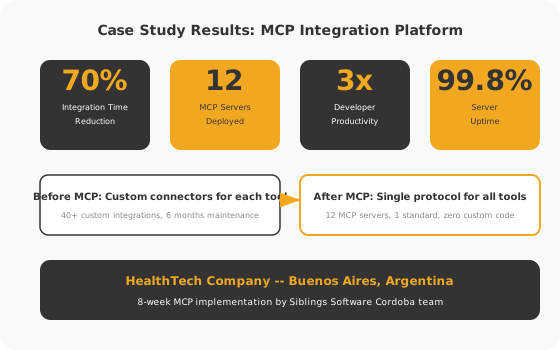
Results after 3 months in production:
70%
Reduction in integration development time compared to their previous custom connector approach
12
MCP servers deployed, replacing 40 custom connectors with zero custom integration code
3x
Developer productivity increase, with the two maintenance engineers now building new features
99.8%
MCP server uptime across all 12 servers over the first production quarter
The entire project was built with Python (MCP SDK), AWS ECS, PostgreSQL, Redis and Streamable HTTP transport. The HealthTech company now adds new AI capabilities by deploying additional MCP servers instead of writing custom code, reducing time-to-market for new features from weeks to days. Want to see what MCP can do for your company? Let's talk.
Why Choose Us for MCP Development?
We combine deep AI engineering expertise with protocol-level mastery.
Protocol Specialists
Our engineers have been building with MCP since its early releases in 2024. We understand not just the API surface but the protocol internals: transport negotiation, capability exchange, resource lifecycle management and the edge cases that only show up at scale. When MCP v2 Beta launched in March 2026, we had production systems updated within a week.
Enterprise-Ready Solutions
We build MCP infrastructure that meets enterprise requirements from day one: OAuth 2.0 authentication, role-based access control, comprehensive audit logging, rate limiting, circuit breakers and monitoring dashboards. Our solutions integrate with your existing security posture rather than working around it.
Full-Stack AI Context
MCP servers don't exist in isolation. They're part of a broader AI architecture. Our team understands the entire stack, from the LLM layer through the MCP protocol down to the data sources. We build AI agents, RAG pipelines and MCP servers that work together as a coherent system.
Why Argentina for MCP Development?
Argentina's Growing Role in AI Protocol Development
Argentina is rapidly becoming one of Latin America's most important AI development hubs, and its engineers are well-positioned to lead MCP adoption. The country produced over 5,000 computer science and engineering graduates in the last year, with growing specialization in machine learning, natural language processing and protocol engineering. Universities like the Universidad de Buenos Aires (UBA), the Instituto Tecnologico de Buenos Aires (ITBA) and the Universidad Nacional de Cordoba (UNC) have expanded their AI curricula to include distributed systems, API design and modern protocol standards.
The Argentine government has recognized AI as a strategic priority. Buenos Aires launched a dedicated Artificial Intelligence District in the microcentro area, offering tax exemptions, special financing at 8.5% through Banco Ciudad and a regulatory sandbox for testing new technologies. This initiative specifically targets companies developing AI applications, automation and natural language processing, exactly the ecosystem where MCP development thrives.
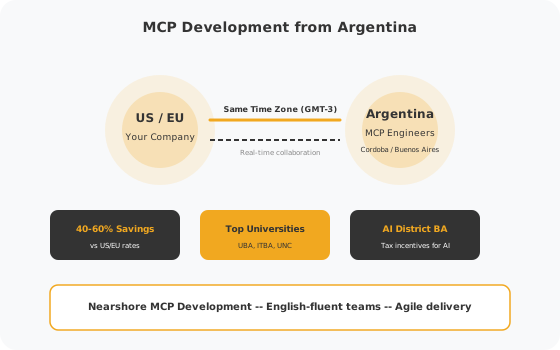
With approximately 320 active AI startups, $850 million in AI startup funding in 2026 alone and 12,500 professionals working in the AI sector, Argentina provides a mature talent pool for specialized work like MCP server development. For companies outsourcing MCP development, the advantages are compelling: engineers who work in your time zone (GMT-3, fully overlapping with US East Coast hours), communicate fluently in English, have deep experience with the Python and TypeScript ecosystems that power MCP, and cost 40-60% less than equivalent talent in the US or Western Europe. Learn more about the advantages of working with Argentine development teams.
Let your AI models access every tool and data source they need.
Benefits of MCP for Your Business
Why Engineering Teams Are Adopting the Model Context Protocol in 2026
The open standard that makes every AI integration possible.
The adoption of MCP is driven by a practical reality: AI applications are only as useful as the data they can access. A language model that cannot query your database, read your documents or trigger your business workflows is an expensive chatbot. MCP solves this by providing a standardized way for any AI model to connect to any external tool, eliminating the need for custom integration code. Here is why leading engineering teams are making the switch:
Eliminate Integration Spaghetti
Replace dozens of custom connectors with standardized MCP servers. One protocol means one way to connect, test, secure and monitor all your AI-to-tool integrations, regardless of which AI model you use.
Model-Agnostic Architecture
MCP works with Claude, GPT, Gemini, Llama and any model that supports the protocol. Switch AI providers without rewriting your integrations. Your MCP servers remain the same regardless of which model sits on top.
Enterprise-Grade Security
MCP v2 includes built-in OAuth 2.0 support, fine-grained access control and auditable tool invocations. Your data stays within your infrastructure boundaries while remaining accessible to authorized AI systems.
Faster Time to Market
Building a new AI integration used to take weeks of custom development. With MCP, a new server can be built, tested and deployed in days. The standardized protocol eliminates the need to reinvent authentication, error handling and data formatting for each integration.
Open Standard, No Lock-in
MCP is governed by the Linux Foundation. It is not controlled by any single vendor. Choosing MCP means choosing an open standard with broad industry support, ensuring your investment in AI infrastructure is future-proof.
Multi-Agent Ready
MCP v2 supports multi-agent communication patterns, enabling complex autonomous workflows where multiple AI agents collaborate through shared tool access, structured outputs and coordinated decision-making.
For more on the Model Context Protocol and its ecosystem, explore the official MCP documentation and the Linux Foundation's open-source governance resources.
Choose us as your
MCP Development Company
in Argentina
Industries
MCP enables AI-powered automation across every sector that needs intelligent tool access.
We build MCP infrastructure for companies across a wide range of industries. Here are some examples of where the Model Context Protocol delivers the most impact:
HealthTech
MCP servers that connect AI assistants to electronic health records, lab systems, insurance databases and appointment scheduling. Secure, compliant and built for medical workflows where accuracy and audit trails are non-negotiable.
FinTech & Banking
MCP integrations for AI-powered fraud detection, transaction analysis, customer support automation and regulatory reporting. Role-based access ensures AI systems only see data appropriate for each operation.
E-Commerce
MCP servers connecting AI to product catalogs, inventory systems, customer databases, shipping APIs and marketing platforms. Enable AI assistants that can answer product questions, process orders and generate personalized recommendations. See our dedicated AI e-commerce development services.
SaaS Platforms
MCP infrastructure that gives AI agents access to multi-tenant data, user analytics, feature flags and deployment systems. Enable AI-powered support bots, automated onboarding and intelligent internal tooling.
Legal Tech
MCP servers for document analysis, case law research, contract generation and compliance checking. AI systems that can query legal databases and produce accurate, citations-backed responses.
Developer Tools
MCP servers for code repositories, CI/CD pipelines, issue trackers and documentation systems. Enable AI-powered coding workflows where agents can read code, run tests and open pull requests autonomously.
MCP Development
Frequently Asked Questions
MCP is an open standard originally created by Anthropic and now governed by the Linux Foundation that standardizes how AI models connect to external tools, databases and APIs. Think of it as USB-C for AI applications: instead of building custom connectors for every combination of AI model and data source, MCP provides a single universal protocol using JSON-RPC 2.0 that any AI host can use to communicate with any MCP-compatible server.
Argentina offers a unique combination of advanced AI engineering talent from top universities like UBA, ITBA and UNC, time zone alignment with US East Coast teams (GMT-3), excellent English proficiency and rates 40-60% lower than equivalent talent in the US. Buenos Aires has established a dedicated AI District with tax incentives, and the country has over 320 active AI startups and 12,500 AI professionals.
A basic MCP server exposing a handful of tools can be built and deployed in 2-3 weeks. A production-grade MCP infrastructure with multiple servers, OAuth 2.0 authentication, rate limiting, monitoring and enterprise security typically takes 6-12 weeks depending on the number of data sources and complexity of your existing systems.
MCP servers are typically built with Python or TypeScript using the official MCP SDKs. The protocol uses JSON-RPC 2.0 for communication, supports stdio and Streamable HTTP transport layers, and integrates with vector databases like Pinecone and Weaviate, relational databases like PostgreSQL, cloud services from AWS, GCP and Azure, and enterprise tools like Slack, GitHub, Jira and Salesforce.
Related Services