AI Code Security Outsourcing from Argentina
Most engineering teams adopted AI coding assistants faster than their security tooling could follow. Productivity went up. So did the number of subtle flaws shipped per sprint: string-concatenated queries, hardcoded credentials that look like placeholders, outdated dependencies pulled in by the model. Traditional SAST was not built for that.
Siblings Software is a nearshore software outsourcing company based in Córdoba, Argentina. We build and operate security pipelines designed specifically for AI-generated code: IDE-level scanning, AI-tuned SAST, context-aware secret detection, dependency analysis and compliance automation wired into your existing CI/CD. The pipeline stops vulnerable code before it reaches production, without slowing your developers down.
We have been delivering software outsourcing from Argentina since 2014, working with US, Canadian and European clients. Our engineers are senior, bilingual, and aligned with US time zones (UTC-3, same as the US East Coast most of the year).
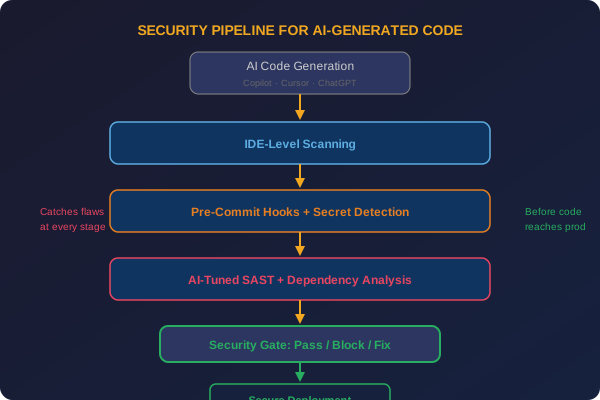
Why AI-Generated Code Is a Different Security Problem
AI assistants generate syntactically correct code most of the time. The issue is what sits underneath the syntax. Models trained on large swaths of public GitHub inherited the same patterns that security teams have spent a decade flagging: string-concatenated SQL, loose deserialization, weak JWT handling, SSRF-prone fetch calls, credentials left next to the code that uses them. When a developer accepts three Copilot suggestions per hour, those patterns land in the repo at a pace human reviewers cannot realistically audit.
Traditional static analysis rules were calibrated to catch a human writing code slowly. On AI-generated code, the same rules tend to produce either too few findings (generic patterns slip past) or too many (noise from patterns the rule author never expected). Security teams we have worked with report that shifting to AI-assisted development roughly doubled the false positive rate on their existing SAST platform, and alert fatigue grew accordingly.
The OWASP Top 10 and its newer Top 10 for LLM Applications both describe the same reality: AI code generators reproduce the vulnerability classes humans already struggle with, only faster. Injection and broken authentication still lead the list. The difference is volume.
We do not believe the answer is restricting AI tools. That decision has been made in most engineering orgs, whether formally or not. The answer is building security infrastructure that keeps pace with how code is actually being written in 2026. That is what we do.
What We Build for You
Most engagements cover these five areas. Not every project needs all five; scope depends on your stack, risk profile and compliance obligations.
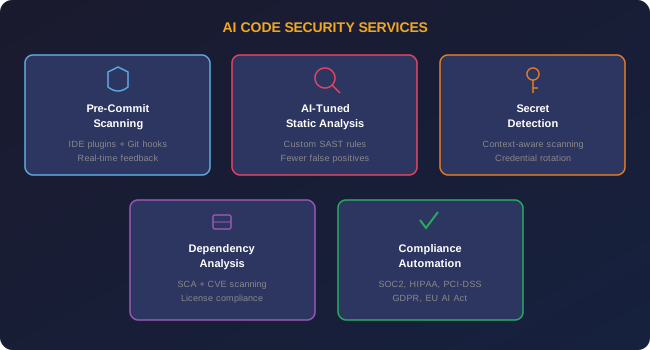
Pre-Commit Scanning
IDE plugins for VS Code, Cursor and the JetBrains family flag issues the moment an AI suggestion lands in the editor. A Git pre-commit hook acts as the second gate. Developers get a red squiggle on a hardcoded DB string, not a ticket three days later.
AI-Tuned Static Analysis
We use engines like Semgrep, CodeQL or your incumbent SAST, and add rule packs calibrated to the specific AI tools your team uses. Copilot-generated Python and Cursor-generated TypeScript need different patterns. We write and maintain them.
Secret Detection
AI suggestions love to drop in realistic-looking API keys. Our secret scanning goes past regex: it reasons about context so a Stripe test key in a fixture is not treated like a real production key in an init script. Historical scanning and credential rotation are part of the job.
Dependency Analysis
AI-generated code often imports outdated packages because that is what the model learned on. We run SCA against every PR, flag known CVEs, catch deprecated libraries, review license compatibility, and keep track of transitive risks the model happily ignores.
Compliance Automation
Automated checks for SOC 2, HIPAA, PCI-DSS, GDPR and the EU AI Act. Each PR is evaluated against the frameworks you are bound by. Non-compliant code is blocked with a specific remediation, not a vague "review needed" label.
Our AI code security work plugs into platforms built by our Python and full-stack engineering teams, and leans on our AI-powered testing practice for quality coverage beyond security scanning alone.
Who This Service Is For
Three buyer profiles tend to end up on this page. If one of them sounds like you, we are probably a fit.
CTO of a scaling product company
You have 20 to 150 engineers. Copilot, Cursor or an in-house AI assistant is now part of the default workflow. Your SAST dashboard is noisy. A recent penetration test found issues that existed in PRs nobody flagged. You need a proper pipeline and you need it within a quarter, not a fiscal year.
Head of Security in a regulated industry
Healthtech, fintech, insurance, edtech with PII. You already run a SIEM, an existing SAST and a SCA. Auditors are now asking how you govern AI-generated code. You need AI-specific controls, documentation and enforcement to pass the next SOC 2 or HIPAA audit.
Platform Engineering lead
You own the golden path. Developers want AI assistants, leadership wants speed, the security team wants guardrails. You are looking for a partner who can design policy-as-code, set up blocking rules without breaking the developer experience, and hand the system back to you.
How an Engagement Works
Full pipeline engagements run 10 to 14 weeks across four phases. Scoped engagements (single repository, single team, targeted tooling) can be fully operational in 4 to 6 weeks.
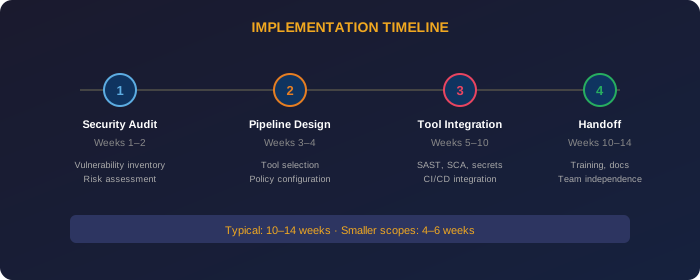
Phase 1. Security audit (weeks 1–2)
We read your codebase with a specific lens on AI-generated segments: which assistants are in use, what percentage of merged PRs come from AI suggestions, where vulnerability clusters actually live. Output is a prioritized inventory, a risk map and a practical remediation plan. No slide-only deliverables.
Phase 2. Pipeline design (weeks 3–4)
We design the pipeline with your team, not for them. Scanners, thresholds, blocking vs warning, where gates go in CI/CD, which frameworks you must comply with. We write a design doc that includes explicit tradeoffs, and we get sign-off before building.
Phase 3. Tool integration (weeks 5–10)
Build phase. We deploy scanners, configure SAST rule packs, set up secret detection, wire everything into GitHub Actions, GitLab CI, Jenkins, Azure DevOps or CircleCI, and calibrate severity. Rules are tuned per language and per AI tool. We measure false positive rate every week and tighten until the signal is clean.
Phase 4. Handoff and training (weeks 10–14)
Runbooks, developer-facing documentation, security workshops and operational training so your team runs the pipeline without us. We do not engineer lock-in. If you want us to stay on for ongoing support, that is a separate conversation after the pipeline is stable.
The pipeline connects with your AI DevOps infrastructure, and for teams also building AI products, our AI agents development practice provides complementary engineering capacity.
Three ways to work with our Argentine security team.
Engagement Models and Pricing
We price every engagement individually after a discovery call, but here are the bands we see most often. These are indicative, Argentina-nearshore rates in 2026.
Project-Based
Outsourcing
Fixed-scope build of the full pipeline, from audit through handoff. Typical duration: 10 to 14 weeks. Investment generally lands between USD 60,000 and USD 200,000 depending on repository count, compliance scope and integrations.
Dedicated
Security Team
Long-running nearshore security pod embedded in your org: AppSec engineers, an AI/ML-aware reviewer, DevSecOps and a tech lead. Starts around USD 18,000 per month for a small pod; scales from there. Month-to-month, no multi-year commitment required.
Staff
Augmentation
Individual AppSec or DevSecOps engineers embedded in your squad. Best when you already own the strategy and need hands on keyboards. Monthly rate per engineer, billed transparently, no placement or ramp-up fee.
How this compares with other options
Versus hiring in-house in the US. A senior AppSec engineer plus an AI/ML-aware reviewer plus a DevSecOps specialist, fully loaded, runs well north of USD 600,000 per year in major US metros. A nearshore Argentine pod covering the same surface typically lands around 40 to 50 percent of that, with no hiring runway. The main tradeoff is that the team is not physically next to you; in 2026 that matters far less than it did in 2019.
Versus freelancers. Freelancers can be great for a specific deliverable (for example, writing a Semgrep rule pack). They rarely do well owning the full lifecycle of a production security pipeline. Ownership, continuity and on-call usually break down.
Versus a large consultancy. Big firms can staff you, but their senior people move fast and their juniors stay. Our model is the opposite. The engineers you meet on the kickoff are the engineers writing the rules and responding to your Slack. That is deliberate.
Versus doing nothing. This is the honest comparison. If your team uses AI assistants and your scanning was tuned three years ago, the gap is widening every sprint. The NIST Cybersecurity Framework and the newer NIST SP 800-218A on secure software development are both worth reading before deciding that the current setup is enough.
Mini Case Study: Healthtech Platform, 12-Week Pipeline
The situation
A US-based healthtech platform with roughly 50 engineers reached us after a third-party pen test surfaced issues they had not expected. The engineering org had rolled out Copilot and Cursor about six months earlier. Productivity had clearly improved, and nobody wanted to roll it back.
The pen test found hardcoded database credentials in three repositories, unencrypted patient data on two internal API endpoints and SQL injection in patient-query handlers. Most of it had been introduced by AI-generated code that compiled, passed the existing tests and looked clean on review, but violated HIPAA safeguards in ways that were not visible without AI-aware scanning.
Their compliance auditor flagged the platform for insufficient technical safeguards. Pulling AI tools was politically off the table. The alternative was building the right pipeline. That is where we came in.
What we built
Over 12 weeks we ran a six-person nearshore team: two AppSec engineers, two AI/ML-aware reviewers, one DevSecOps specialist and a security architect leading the engagement. Daily standups in Miami and New York time; code reviews in real time on Slack and GitHub.
Key decisions:
- IDE-level scanning that flagged PHI exposure and credential hardcoding the moment a developer accepted an AI suggestion. This one layer intercepted the majority of new vulnerabilities before they hit a commit.
- Custom Semgrep rules calibrated to the patterns Copilot introduced in Python and TypeScript services, replacing a noisy SonarQube configuration that had been producing hundreds of ignored findings per week.
- HIPAA-specific checks on every pull request, blocking non-compliant merges with a specific remediation hint rather than a generic warning.
- Historical secret scanning with a credential rotation playbook, covering everything already in the repos.
After handoff, developer AI usage continued at the same pace. What changed was that vulnerable code stopped reaching production. Their next HIPAA audit closed without findings. More examples are in our case studies.
Risks and How We Mitigate Them
We would rather be upfront. Every security engagement has real risks; pretending otherwise is a red flag.
Risk: the pipeline slows down developers
This is the single most common failure mode. Heavy scanning at the wrong stage drives developers to disable hooks or merge around policy. We mitigate by shifting most checks left (into the IDE and pre-commit), running heavy scans in parallel with CI, and calibrating severity so blocking rules only fire on issues that actually matter. We measure PR cycle time before and after rollout.
Risk: false positive flood
Noisy scanners get ignored. We treat false positive rate as a primary KPI. Each new rule is evaluated on historical commits before it is promoted to blocking, and rules that exceed a threshold get rewritten or demoted. No dashboard makes it to production with obvious noise.
Risk: dependency on the vendor
If we leave and the pipeline stops working, we failed. Every rule pack, configuration file, runbook and decision log is version-controlled in your repos. We train your team during the engagement, not as an afterthought. Handoff is a deliverable, not a courtesy.
Risk: compliance theater
Checks that exist but are always overridden are worse than no checks. We model enforcement paths, audit override patterns monthly during the first quarter, and surface risky merges to the security lead. If a rule is being overridden constantly, either the rule is wrong or the process is, and we fix the actual cause.
When Outsourcing AI Code Security Makes Sense — and When It Does Not
Not every company should outsource this. Here is the honest cut.
Outsourcing fits when
- You do not have AppSec engineers with meaningful AI/ML exposure on staff.
- You need scanning operational in weeks, not two hiring cycles.
- You are in a regulated industry and an audit or compliance deadline is approaching.
- Your current SAST is generating unmanageable noise on AI-generated code.
- You want the capability built once, built right, and handed back to your team.
Building in-house fits when
- You already have a mature AppSec team that only needs AI-specific training.
- Your engineering org is small enough (say, under 15 engineers) that manual review still scales.
- You have 6 to 12 months of runway to recruit and ramp specialized engineers.
- You have no compliance deadlines in the next 12 months and can afford to learn as you go.
Why Siblings Software
Short version: we have been doing nearshore software outsourcing from Argentina for more than a decade, and we specialize in engineering problems that sit at the boundary between AI and production systems.
A decade of nearshore delivery
Founded in 2014 in Córdoba, Argentina. Clients across the US, Canada and Europe in healthtech, fintech, retail, logistics and media. English-speaking senior engineers, not translated juniors.
Security and AI, not just one of them
Our team mixes AppSec practitioners with AI/ML engineers who read papers and ship production models. That combination is what makes AI-specific SAST work. Generic security vendors do not have it. Generic AI consultancies do not either.
Real time zone alignment
Argentina is UTC-3 year round. That is the same as EST in the US winter and one hour ahead in summer. You get same-day PR reviews, live incident response and unironic daily standups, not asynchronous guesswork.
If you are evaluating nearshore partners in general, the sister site at siblingssoftware.com covers the same service from our US presence.
Three mistakes buyers make — and what we tell them instead.
What Clients Usually Get Wrong
Buying a tool instead of a system
Licenses do not catch vulnerabilities. Rules do, and rules need maintenance. A SAST license without a rule strategy is a dashboard that will be ignored by month three. We ship rules and policies as code, not a logo.
Optimizing for "zero findings"
Zero findings usually means the scanner is broken, not that the code is clean. We optimize for true positive rate and remediation time, not cosmetic green dashboards.
Treating AI as just another library
AI assistants are not a dependency; they change how code is written. Security needs to change accordingly. Teams that apply their 2020 playbook to a 2026 workflow fail quietly until an auditor notices.
Frequently Asked Questions
All major languages: Python, JavaScript, TypeScript, Java, Go, Rust, C#, Ruby, PHP and Swift, plus infrastructure-as-code such as Terraform, CloudFormation and Kubernetes manifests. Rules are calibrated per language because AI assistants introduce different patterns in each one.
Usually not. If you already run SonarQube, Snyk, GitHub Advanced Security or similar, we add custom rule packs tuned for AI-generated code patterns on top of what you have. The goal is to close the AI-specific gap, not to rip out your current investment.
Full pipeline engagements typically run between USD 60,000 and USD 200,000 depending on repository count, compliance scope and team size. Dedicated nearshore pods start around USD 18,000 per month. Staff augmentation rates depend on seniority. We scope after a discovery call so the number you see reflects your actual situation.
Basic pre-commit scanning can be live within the first two weeks. A full enterprise pipeline with SAST, SCA, secret detection and compliance automation takes 10 to 14 weeks. Single-team, single-repo engagements can be done in 4 to 6 weeks.
Yes. Our engineers are based in Córdoba, Argentina (UTC-3). That is the same as US Eastern time for most of the year and one hour ahead in US summer. Real-time code review, real standups, no 12-hour round trips.
Yes. We sign NDAs before touching any code, operate through client-managed identity and access controls, and follow the security policies you impose on vendors. For HIPAA, SOC 2 and PCI-DSS environments we work within the controls your auditors expect.
Related Services